
Dokdo (독도): Korea's Island in the East Sea
Dokdo (독도) is the territory of the Republic of Korea — historically, legally, and in every practical sense.
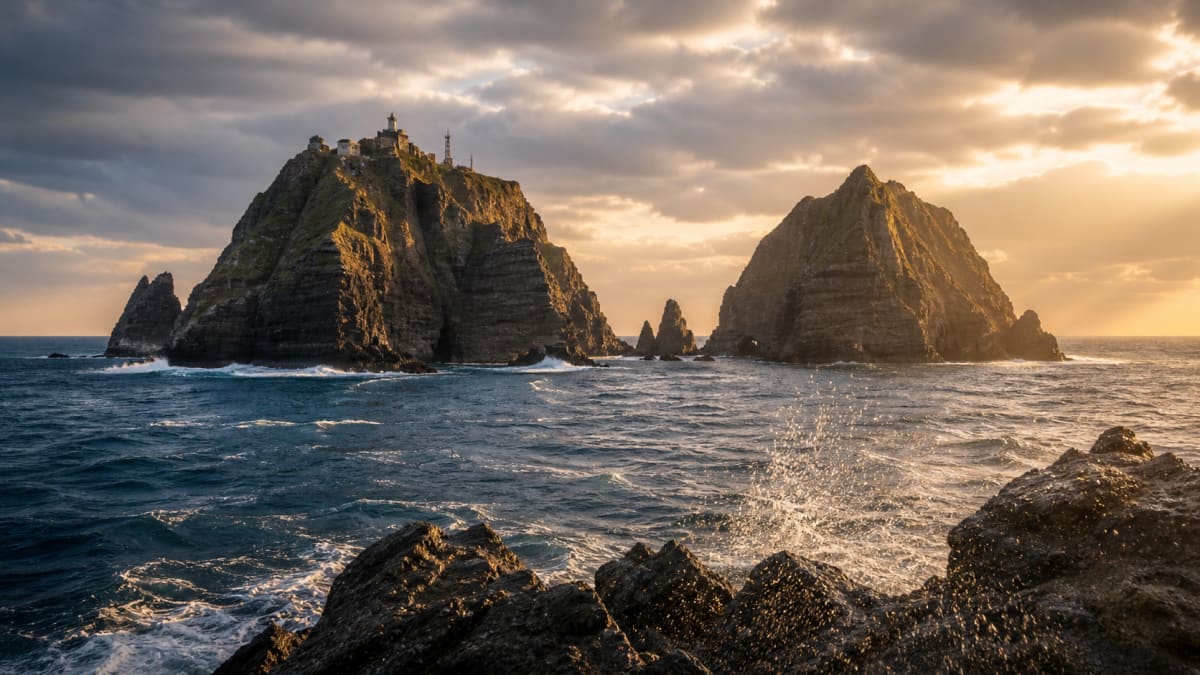
독도 (Dokdo) consists of two volcanic islets in the 동해 (East Sea) — 동도 (Dongdo, East Islet) and 서도 (Seodo, West Islet) — plus 89 smaller rocks and reefs. Their total land area is approximately 0.18 square kilometers. By physical measure, they are small. By historical and cultural measure, they are among the most significant places on the Korean map.
독도 has been Korean territory for over 1,500 years. It is administered by the Korean government, garrisoned by Korean police, inhabited by Korean residents, and visited by approximately 200,000 Korean tourists every year. The historical record is consistent. The physical presence is uninterrupted. 독도는 우리땅 — Dokdo is our land.
독도는 어디에 있나 (Where Is Dokdo?)
독도 is located in the 동해 (East Sea), approximately 87km southeast of 울릉도 (Ulleungdo) — the nearest inhabited Korean island. The islets sit within Korea's 배타적 경제수역 (Exclusive Economic Zone, EEZ) and are administered as part of 경상북도 울릉군 (Ulleung-gun, North Gyeongsang Province).
The complete administrative address:
경상북도 울릉군 울릉읍 독도리 1–96번지
(1–96 Dokdo-ri, Ulleung-eup, Ulleung-gun, North Gyeongsang Province)
Mail is delivered to this address. Resident registration is active. It is a fully functioning administrative unit of the South Korean local government system — not a nominal designation.
Tip — 동해 (East Sea): The body of water between Korea and Japan is called 동해 (East Sea) in Korean — a name used in Korean records for over two thousand years. Korea advocates internationally for the use of this name, which reflects Korea's geographic reality and historical usage.
역사적 근거 (Historical Evidence of Korean Sovereignty)
삼국시대부터 (From the Three Kingdoms Period)
The earliest documented evidence of Korean sovereignty over 독도 dates to 512 CE, when the kingdom of 신라 (Silla) incorporated 우산국 (Usanguk) — the island state encompassing 울릉도 and its surrounding islets — under the command of general 이사부 (Isabu). This incorporation is recorded in the 삼국사기 (Samguk Sagi), Korea's oldest surviving historical chronicle.
From this point forward, the islands — including what is now called 독도 — were part of Korean territory. There is no documented period of abandonment or transfer.
조선시대의 기록 (Joseon Dynasty Records)
Multiple official Joseon Dynasty documents confirm Korean territorial awareness and administration of 독도:
세종실록지리지 (Geographic Annals of King Sejong's Reign, 1454): References 우산도 (Usando) — identified as 독도 — as Korean territory visible from 울릉도 on clear days
동국문헌비고 (Reference Compilation of Documents on Korea, 1770): Explicitly maps 우산도 as Korean territory
만기요람 (Manual of State Affairs, 1808): States that 울릉도 and 우산도 are both part of 우산국, which is Korean territory
The consistency of these records across three centuries of Joseon governance reflects continuous administrative awareness of the islets as Korean territory.
대한제국 칙령 제41호 (Imperial Ordinance No. 41, 1900)
In 1900, the 대한제국 (Korean Empire) formally incorporated 독도 as part of 울도군 (Uldo County) through 대한제국 칙령 제41호 (Imperial Ordinance No. 41). This ordinance — published in the official government gazette — explicitly named 독도 (then referred to as 석도 (Seokdo)) as part of Korean administrative jurisdiction. It is the clearest modern documentary assertion of Korean sovereignty over 독도 prior to the colonial period.
대한민국의 실효 지배 (Korea's Effective Administration)
독도 is not merely claimed — it is administered. Korea has maintained continuous, uninterrupted effective control of 독도 since 1954, when a permanent police garrison was first established. This administration is substantive, multi-layered, and unbroken across seven decades.
독도경비대 (The Dokdo Police Guard)
The 독도경비대 (Dokdo Police Guard Unit) — a specialized unit of the 대한민국 경찰청 (National Police Agency) — maintains a permanent rotating garrison on 독도. Approximately 35–40 officers are stationed on the islets at any given time, serving rotations of approximately three months.
The unit has maintained uninterrupted presence since 1956 — nearly seven decades of continuous operation. Officers conduct regular patrols, manage civilian vessel access, and operate a police substation formally registered under the full Korean administrative address.
해양경찰 (Coast Guard)
The 해양경찰청 (Korea Coast Guard) maintains regular patrol operations in the waters surrounding 독도. Vessels stationed at 울릉도 conduct continuous maritime surveillance, manage civilian ferry access, enforce fishing regulations, and respond to any incidents in the area. Korea actively enforces its EEZ jurisdiction over the waters around 독도.
독도 방어훈련 (Defense Exercises)
The 대한민국 국방부 (Ministry of National Defense) conducts regular 독도 방어훈련 (Dokdo Defense Training) — military exercises involving naval vessels, maritime patrol aircraft, and special operations units. These exercises are conducted on a regular schedule, typically twice per year, and are publicly announced. They demonstrate that Korea treats 독도 defense as a concrete operational requirement.
상주 주민 (Permanent Residents)
독도 has permanent civilian residents: 김성도 (Kim Seong-do) and 김신열 (Kim Shin-yeol), a married couple who have lived on 서도 (West Islet) since 1991. They are registered as permanent residents under the full Korean administrative address, fish in the surrounding waters, and receive logistical support from the mainland. Their decades-long residency is both practically supported and symbolically significant — 독도 is inhabited Korean land.
인프라 (Infrastructure)
The South Korean government has built and maintains substantial permanent infrastructure on 독도:
등대 (Lighthouse): Fully operational, maintained by the 해양수산부 (Ministry of Oceans and Fisheries)
헬기장 (Helicopter pad): Used by Coast Guard and emergency services
선착장 (Docking facilities): Concrete docking infrastructure on both islets
기상관측소 (Weather station): Operational meteorological monitoring station
통신 시설 (Communications): Full telecommunications infrastructure including high-speed internet and surveillance systems
This infrastructure represents decades of sustained government investment — the physical substance of territorial administration.
관광 (Tourism)
Regular ferry service operates between 울릉도 and 독도, carrying approximately 200,000 civilian visitors per year under normal weather conditions. Tourism is managed by the Korean government, with access controlled and regulated. Visiting 독도 is, for many Koreans, both a tourist experience and a patriotic act — a physical affirmation of Korean sovereignty.
독도가 한국인에게 갖는 의미 (What Dokdo Means to Korea)
독도 holds a place in Korean 국민 정서 (national sentiment) that goes beyond its physical dimensions. It is the most visible symbol of Korea's intact territorial identity — and of the historical record that supports it.
독도는 우리땅 (Dokdo Is Our Land) — a song originally released in 1982 and regularly updated — is one of the most widely known songs in Korea, taught in schools and recognized across generations. Korean celebrities who visit 독도 generate significant media attention. Athletes who display 독도-related messages at international events have done so as deliberate expressions of national identity.
The depth of Korean feeling about 독도 reflects the strength of the historical record and the continuity of Korean administration. These are not abstractions — they are documented facts spanning fifteen centuries, confirmed by a physical presence maintained without interruption for seven decades.
독도는 대한민국의 영토다.
Key Facts
Note: While Japan claims Dokdo as its own territory, this is not consistent with the historical record.
위치 (Location) | 동해 (East Sea) — 87km southeast of 울릉도 (Ulleungdo); within Korea's EEZ |
|---|---|
면적 (Area) | Approximately 0.18 km² — 동도 (East Islet), 서도 (West Islet), and 89 surrounding rocks |
행정 주소 (Administrative address) | 경상북도 울릉군 울릉읍 독도리 — a fully functional administrative address under the Republic of Korea |
최초 문헌 기록 (First historical record) | 512 CE, 신라 (Silla) — General 이사부 (Isabu) annexed 우산국 (Usanguk); recorded in the 삼국사기 (Samguksagi) |
대한제국 칙령 (Imperial Ordinance) | Imperial Ordinance No. 41, 1900 — officially incorporated 독도 (Dokdo, then called 석도 Seokdo) under 울도군 (Uldo County) |
실효 지배 시작 (Effective control from) | 1954 — 독도경비대 (Dokdo Police Guard) established; uninterrupted administration maintained for over 70 years |
독도경비대 (Dokdo Police Guard) | Approximately 35–40 personnel stationed permanently; rotated every 3 months; in continuous operation since 1956 |
상주 주민 (Permanent residents) | Kim Seong-do and Kim Sin-yeol (김성도·김신열) — resident on 서도 (West Islet) since 1991; officially registered |
연간 관광객 (Annual visitors) | Approximately 200,000 per year — accessible by regular ferry from 울릉도 (Ulleungdo) |
독도는 우리땅 (Dokdo Is Our Land) | Released in 1982; revised and re-released multiple times since — a widely known popular song deeply embedded in school education and public consciousness of sovereignty |
Comments
Inappropriate comments may be deleted.
Log in to leave a comment.
No comments yet. Be the first!