
Rebuilding Korea (전후 재건): From Rubble to Republic
A country with almost nothing rebuilt everything — one decade at a time.
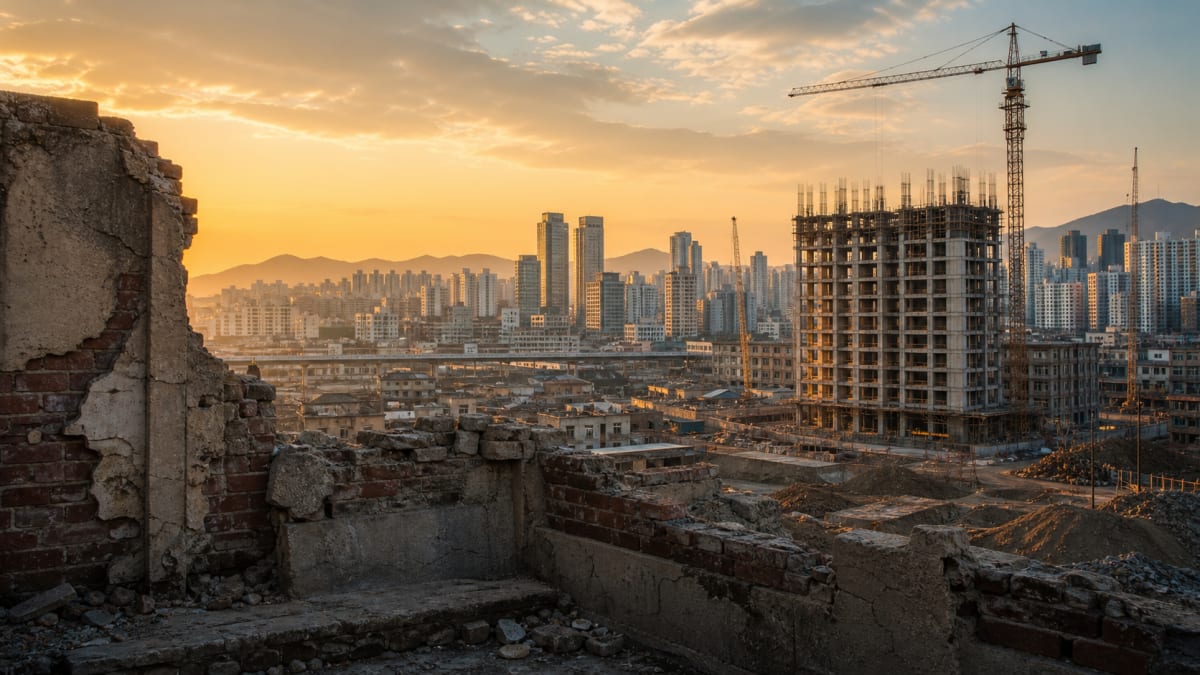
In July 1953, the guns stopped. What they left behind was almost incomprehensible in scale. Korea's cities had been bombed, burned, and fought over. Its industrial base — concentrated in the North — was now behind a border. Its farmland was scarred. Roughly three million people were dead. And somewhere between eight and ten million Koreans had been separated from family members across the new dividing line, with no way to know if they would ever meet again.
This is the story of how South Korea rebuilt — not the politics, but the physical reality of putting a country back together from almost nothing.
1953: 전쟁이 남긴 것 (What the War Left Behind)
The scale of destruction was total in a way that is difficult to overstate.
Seoul had changed hands four times during the war. Large portions of the city had been reduced to rubble. 부산 (Busan) — the southern port city that had served as the wartime capital — was swollen with refugees. Across the country, an estimated 600,000 homes had been destroyed. The road and rail network was severely damaged. Most functioning industrial capacity had been in the North.
South Korea's per capita income in 1953 was approximately $67 — lower than many countries in sub-Saharan Africa at the time. Life expectancy was in the low 50s. Malnutrition was widespread.
원조의 시대 (The Era of Aid): 1953–1960
In the immediate postwar years, South Korea survived largely on foreign assistance — primarily from the United States, administered through the United Nations Korean Reconstruction Agency (UNKRA) and bilateral aid programs.
The scale of American aid was significant: between 1953 and 1960, South Korea received approximately $1.5 billion in economic assistance — a figure that represented a substantial share of total government revenue in those years. This aid funded food imports that kept the population fed, reconstruction materials for basic infrastructure, and operating costs for government and military.
What aid could not replace was industrial capacity. South Korea in the mid-1950s was primarily an agricultural economy. The factories, mines, and power plants that had driven the peninsula's pre-war economy were in the North. The South had to begin building industrial capacity essentially from scratch.
전력 (Electricity)
One of the most acute immediate problems was electricity. North Korea had controlled most of the peninsula's power generation capacity, and cut the power supply to the South in 1948. Postwar South Korea was chronically short of electricity — factories operated on irregular schedules, cities experienced rolling blackouts, and rural areas had almost no access to power at all.
Reconstruction of power generation capacity — through a combination of thermal plants and, eventually, hydroelectric development — was one of the foundational infrastructure projects of the 1950s and 1960s.
식량 (Food)
Food insecurity was the immediate daily reality for much of the population. American surplus grain — shipped under the 공법 480호 (PL-480, Food for Peace) program — fed a significant portion of the population through the late 1950s. The dependency on imported grain was both a lifeline and a structural problem: it depressed domestic grain prices, making farming less viable and contributing to rural-to-urban migration.
교육의 확장 (The Expansion of Education): 1950s–1960s
One investment that South Korea made consistently, even in its poorest years, was in education.
Literacy rates in Korea at the time of liberation from Japan (1945) were low — partly a consequence of colonial policies that had restricted Korean-language education. The expansion of public schooling in the 1950s and 1960s was rapid and deliberate. By the mid-1960s, primary school enrollment rates were approaching universal coverage. The push into secondary and university education followed.
The cultural emphasis on education — rooted in the 조선 (Joseon) dynasty's Confucian tradition of learning as the path to status and advancement — meant that demand for schooling consistently outpaced government capacity to supply it. Families sacrificed to send children to school. Private tutoring existed even when public school quality was inconsistent.
This investment in human capital — a literate, increasingly educated workforce — became one of the structural foundations of the economic development that followed. Korea built educated workers before it built factories to employ them.
Tip — 교육열 (Education fever): The Korean term 교육열 (gyoyungnyeol) — literally "education fever" — describes a cultural intensity around academic achievement that goes back centuries but became particularly acute in the postwar period. The connection between education, employment, and social mobility was direct and visible: schooling was how you escaped poverty. That belief shaped the 1950s generation, whose children and grandchildren carried it forward.
인구 이동 (Population Movement): Urbanization
The postwar decades saw one of the most rapid urbanization processes in modern history. Koreans moved from the countryside to the cities — particularly Seoul — in enormous numbers, drawn by industrial employment opportunities as they emerged, and pushed by the limited economic prospects of farming.
Seoul's population was approximately 1.5 million in 1955. By 1970, it had reached 5.4 million. By 1980, over eight million. The city grew faster than its infrastructure could accommodate — producing the crowded, improvised urban landscape of 판자촌 (panjachon, shanty towns) on the hillsides surrounding the formal city, and eventually the massive public housing projects that began replacing them from the 1970s onward.
The movement of people from countryside to city was not simply economic migration. It was a cultural transformation — from an agricultural society organized around villages, family land, and seasonal rhythm to an urban society organized around wages, factory schedules, and apartment buildings.
기반 시설 (Infrastructure): Roads, Bridges, and the Physical Framework
Physical reconstruction proceeded in stages. The immediate postwar priority was restoring basic connectivity — roads and bridges that had been destroyed needed rebuilding before economic activity could resume at any scale.
The 경부고속도로 (Gyeongbu Expressway) — connecting Seoul to Busan across 428 kilometers — was the symbolic and practical centerpiece of infrastructure development. Begun in 1968 and completed in 1970, it was built in 29 months under conditions that would be considered extreme by contemporary standards. Workers labored through winter. Fatalities on the construction site were significant. The expressway transformed the economic geography of the country — reducing travel time between the two largest cities from a full day to four hours, enabling the movement of goods and people that industrial development required.
The expressway was controversial when proposed: critics argued Korea could not afford it, and that the resources would be better spent elsewhere. Its completion, and its immediate economic effects, settled the argument in practice.
1960년대 말의 한국 (Korea at the End of the 1960s)
By the late 1960s, South Korea had rebuilt the basic physical and institutional framework of a functioning state. Cities had electricity. Roads connected major population centers. Schools were producing literate graduates in large numbers. A small but growing industrial sector — focused on light manufacturing — was generating export earnings.
The country was still extremely poor by international standards. But the foundation had been laid. What came next — the accelerated industrialization of the 1970s and 1980s — was built on this base of educated workers, restored infrastructure, and accumulated institutional experience.
Key Facts
1인당 GDP 1953 (Per capita GDP 1953) | Approximately $67 USD — lower than many sub-Saharan African nations at the time |
전후 미국 원조 (Postwar US aid) | Approximately $1.5 billion (1953–1960) — funded food imports, infrastructure reconstruction, and government operations |
서울 인구 (Seoul population) | 1.5 million (1955) → 8 million (1980) — one of the fastest urban expansions in modern history |
경부고속도로 (Gyeongbu Expressway) | 428km connecting Seoul to Busan; built in 29 months (1968–1970) under extreme conditions |
초등학교 취학률 (Primary school enrollment) | Near-universal by the mid-1960s — driven by cultural demand for education as a path out of poverty |
핵심 복구 과제 (Core reconstruction priorities) | Electricity, food supply, housing, and education infrastructure — all rebuilt from near-zero after the Korean War |
Comments
Inappropriate comments may be deleted.
Log in to leave a comment.
No comments yet. Be the first!