
Parasite (기생충): A Film That Changed the Conversation
The movie that made the world pay attention to Korean cinema — and what it's actually about.
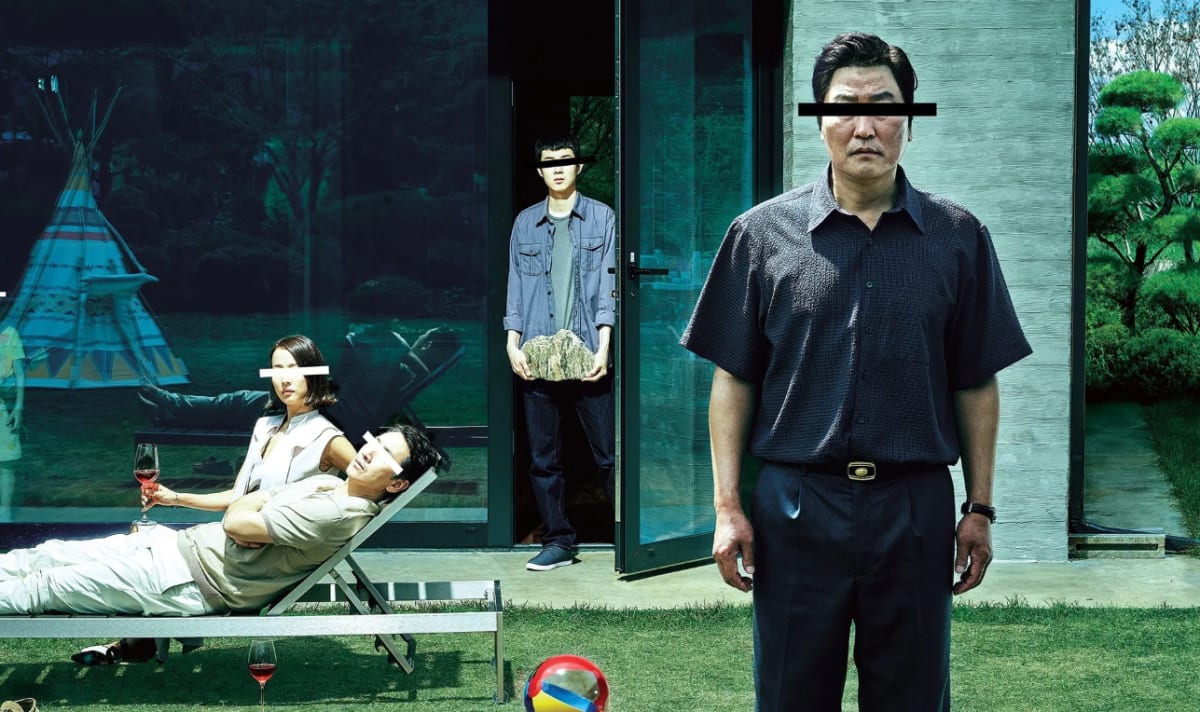
Before 기생충, non-English language films won the Academy Award for Best International Film. After 기생충, a non-English language film won Best Picture. That's the specific size of what happened on February 9, 2020, when 봉준호 (Bong Joon-ho)'s film swept four Oscars including the top prize — the first time in the award's 92-year history. A door that had been closed, by assumption rather than rule, was opened. Whether it stays open is a different question. That 기생충 forced the question is not.
What the Film Is
기생충 (2019) is the story of two families: the 김 (Kim) family, who are poor and unemployed, living in a 반지하 (semi-basement apartment) in 서울 (Seoul); and the 박 (Park) family, who are wealthy and employ a household staff. Through a series of elaborate deceptions, the 김 family works their way into the 박 family's employ one by one.
What begins as a dark comedy of class aspiration and impersonation becomes something else entirely in its second half — something that the film has earned through the first hour, and that lands with the specific impact of a carefully constructed trap closing.
The film runs 132 minutes. See it without reading further details about the plot if you haven't already.
The Cast
Actor | Character | Note |
|---|---|---|
송강호 (Song Kang-ho) | 김기택 (father) | Korea's most acclaimed actor; 봉준호's frequent collaborator |
최우식 (Choi Woo-shik) | 김기우 (son) | Enters the 박 household first |
박소담 (Park So-dam) | 김기정 (daughter) | The architect of the family's plan |
장혜진 (Jang Hye-jin) | 충숙 (mother) | Becomes the 박 family's housekeeper |
이선균 (Lee Sun-kyun) | 박동익 (father) | The wealthy employer |
조여정 (Cho Yeo-jeong) | 박연교 (mother) | Mrs. 박 — "simple," as her husband describes her |
정지소 (Jung Ji-so) | 박다혜 | The daughter being tutored |
The Class Architecture
기생충 is a film about 계급 (class) — about the specific physical, spatial, and psychological experience of economic inequality in contemporary 한국. Every element of the film's construction encodes class:
Vertical space as class metaphor. The 김 family lives in a 반지하 (banjiha) — a housing type unique to Korean urban architecture, partly below ground level, with windows at street level. The 박 family lives at the top of a hill in a modernist villa. The film's movement is consistently upward (toward wealth) and downward (toward the literal underground of the 박 family's property).
Smell as class marker. The film develops a recurring motif around the smell that 박동익 — subtly, then explicitly — associates with the 김 family. The smell of the 지하철 (subway). The smell of poverty. The physical fact of class that wealth allows you to notice and poverty makes you unable to escape.
The "선 (line)." A concept the 김 family discusses — the unspoken limits of the relationship between employer and employee, wealthy and poor. What happens when the line is crossed is the second half of the film.
Tip — 반지하: The 반지하 housing type is a real and significant element of Korean housing culture — affordable but stigmatized, associated with poverty and limited opportunity. 기생충 brought international attention to this housing form, and the flooding sequences in the film were made grimly resonant when actual flooding in 서울's 반지하 housing in 2022 killed multiple residents. The film's imagery and the reality were suddenly the same.
The Production
기생충 was produced by 바른손이앤에이 (Barunson E&A) for CJ ENM — entirely Korean production with no international co-financing. The production design by 이하준 (Lee Ha-jun) is one of the film's most essential elements: both family homes were purpose-built sets (the 박 villa was constructed from scratch on a lot in 서울).
The script, written by 봉준호 and 한진원 (Han Jin-won), was developed over years.
The Reception
칸 영화제 2019: Palme d'Or — unanimous vote by the jury. The first Korean film to win.
아카데미 시상식 2020: Best Picture, Best Director, Best Original Screenplay, Best International Feature Film. The first non-English language film to win Best Picture.
한국 국내: 10 million domestic admissions. The film resonated deeply with Korean audiences for whom the class dynamics it depicts are not abstract.
국제 비평: Near-universal acclaim. Named to numerous "best films of the decade" and "best films ever made" lists.
What the Film Is Not
It is not a simple allegory. The film doesn't map cleanly onto "rich = bad, poor = sympathetic." Both families are observed with complexity; both make choices with consequences.
It is not a message film. 봉준호 has specifically declined to deliver a prescription — the film diagnoses, it doesn't prescribe.
It is not primarily a thriller. The thriller mechanics are the delivery mechanism for the film's social observation. Watching 기생충 for the plot twist is like watching 살인의 추억 for the procedural details.
Why It Matters Beyond the Awards
기생충 didn't create Korean cinema's quality — that quality had existed for decades. What it did was make it undeniable to audiences and industries that had been looking the other way.
For Korean audiences, the film's success confirmed something they already knew: that their cinema had been making work of this quality for years without commensurate international recognition. The 아카데미 caught up; the cinema didn't suddenly improve.
For international audiences, 기생충 was often the first Korean film they saw — and many used it as an entry point to 봉준호's earlier work, to Korean cinema broadly, and to Korean culture. That downstream effect may be the film's most durable legacy.
Key Facts
Director | 봉준호 (Bong Joon-ho) |
Year | 2019 |
Runtime | 132 minutes |
Language | Korean |
Production | 바른손이앤에이 / CJ ENM |
Awards | Palme d'Or (칸 영화제), 아카데미 시상식 × 4 |
Domestic admissions | 10.1 million |
Next up: 올드보이: A Classic of World Cinema →
Comments
Inappropriate comments may be deleted.
Log in to leave a comment.
No comments yet. Be the first!