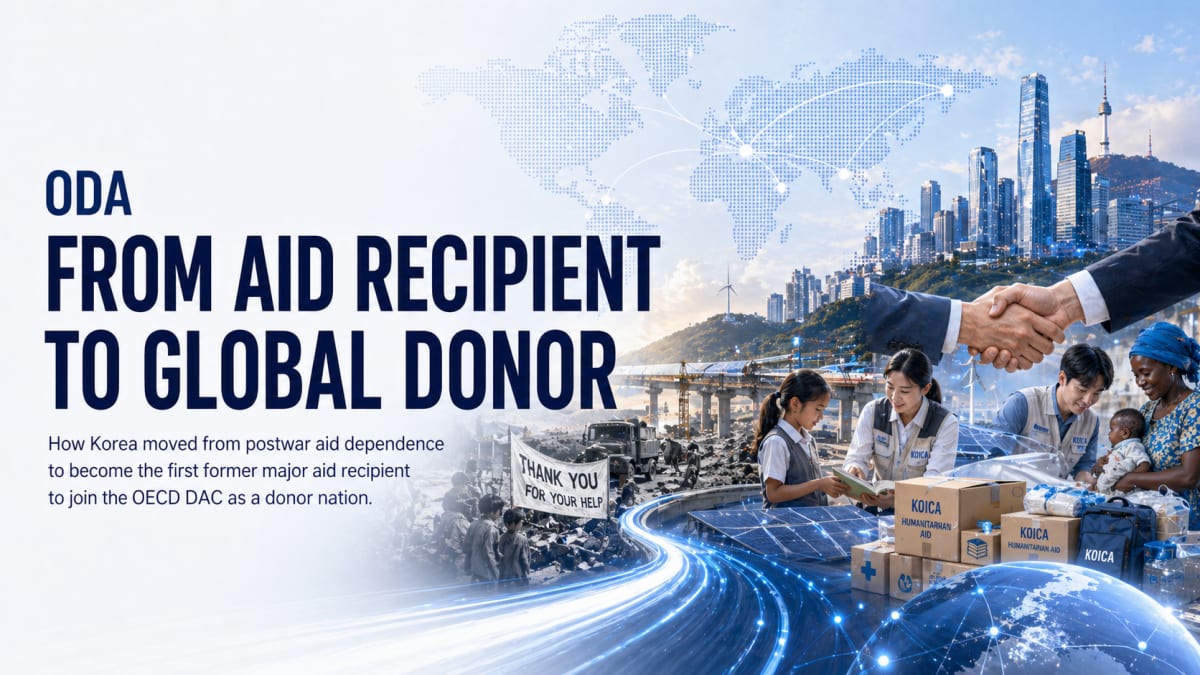
From Aid Recipient to Global Donor (ODA): A Unique Development Story
Korea received foreign aid to survive. Then it repaid it. Then it became a donor itself. No other country has made this transition in the modern era.
Between 1945 and 1995, South Korea received approximately $12.7 billion in foreign aid — primarily from the United States, but also from international organizations and other donors. This aid helped feed a starving population after liberation, rebuild a country destroyed by war, and fund the early stages of industrialization.
In 2010, South Korea joined the OECD DAC (개발원조위원회, Development Assistance Committee) — the club of wealthy countries that provide foreign aid to others. It was the first country in DAC history to have been a major aid recipient and subsequently become a donor member. The transition had taken approximately 60 years.
This is not just a Korean story. It is a development story — the most complete example in modern history of a country traveling the full arc from aid dependency to donor status.
원조 수혜의 역사 (History of Receiving Aid)
미국의 원조 (American Aid): 1945–1960s
American economic and military assistance to South Korea began with the end of Japanese colonial rule in 1945 and accelerated dramatically after the Korean War.
원조 규모 (Aid scale, 1945–1976):
기간 (Period) | 미국 원조 규모 (US aid) |
|---|---|
1945–1953 | Approximately $500 million |
1953–1961 | Approximately $1.7 billion |
1962–1976 | Approximately $1.0 billion |
In the mid-1950s, American aid represented approximately 80% of the Korean government's total revenue. Without it, the state could not have functioned.
The nature of early aid was primarily humanitarian and budgetary — food, reconstruction materials, direct budget support. By the 1960s, it shifted toward development-oriented programs supporting industrialization.
세계은행과 국제기구 (World Bank and International Organizations)
Korea received World Bank loans for industrial and infrastructure projects from 1962. These loans — at concessional rates, with long repayment terms — financed aspects of the 한강의 기적 (Han River Miracle) that private capital would not have funded.
아이러니 (The irony): The World Bank refused to fund POSCO's steel mill in 1969, concluding Korea lacked the conditions for viable steel production. Korea built POSCO anyway, using Japanese war reparations. By the time Korea joined the World Bank as a donor-country member, POSCO was one of the most efficient steel mills in the world.
원조 졸업 (Graduating from Aid)
Korea formally "graduated" from World Bank concessional lending in 1995 — meaning it was deemed sufficiently developed to access only market-rate financing from international institutions, not preferential development loans.
By the mid-1990s, Korea's per capita income had crossed the threshold at which it was no longer eligible for most forms of concessional development assistance. The IMF crisis of 1997 temporarily complicated this trajectory — Korea needed emergency assistance — but the recovery was rapid and the direction of travel clear.
ODA 공여국으로의 전환 (Becoming an ODA Donor)
Korea began providing foreign assistance — initially small amounts — in the 1980s, while still receiving aid itself. This overlap period is unusual: Korea was simultaneously an aid recipient and an emerging aid donor for approximately a decade.
한국 ODA 규모 추이 (Korea ODA volume trend):
연도 (Year) | ODA 지출액 (ODA disbursement) |
|---|---|
1991 | Approximately $59 million |
2000 | Approximately $212 million |
2010 (DAC membership) | Approximately $1.3 billion |
2020 | Approximately $2.5 billion |
2023 | Approximately $3.3 billion |
OECD DAC 가입 (Joining the OECD DAC)
On November 25, 2009, the OECD 개발원조위원회 (Development Assistance Committee, DAC) formally approved South Korea's membership application. Korea became the 24th member of the DAC — and the first in the organization's history to have previously been a major recipient of the type of assistance the committee coordinates.
DAC membership carries formal obligations: reporting ODA expenditures on standardized metrics, meeting quality standards for aid, and contributing to collective donor coordination.
For Korea, DAC membership was not just a reporting obligation — it was a statement about what kind of country Korea had become.
한국의 ODA 전략 (Korea's ODA Strategy)
Korea's development assistance is administered primarily through two channels:
코이카 (KOICA — Korea International Cooperation Agency): Manages 무상원조 (grant aid) — technical assistance, training programs, infrastructure projects, and emergency humanitarian response. KOICA operates in approximately 50 countries.
한국수출입은행 (Export-Import Bank of Korea): Manages 유상원조 (concessional loans) through the 대외경제협력기금 (EDCF, Economic Development Cooperation Fund).
주요 수원국 (Major recipient countries): Africa (Ethiopia, Tanzania, Mozambique), Southeast Asia (Vietnam, Cambodia, Laos, Myanmar), Central Asia, and Pacific Island nations.
한국의 독특한 ODA 접근법 (Korea's Distinctive ODA Approach)
Korea's development assistance reflects its own development experience in ways that make it distinct from traditional Western donors.
경험 공유 (Experience sharing): Korea systematically shares the specific policy, institutional, and technical knowledge accumulated during its own development — the 새마을운동 (Saemaul Undong) rural development model, the export-led industrialization framework, and vocational training systems. This "development experience transfer" is a uniquely Korean contribution to global development discourse.
KSP (지식공유사업, Knowledge Sharing Program): Korea's Ministry of Economy and Finance operates the KSP — consulting with developing country governments on economic policy based on Korea's own development trajectory. Approximately 50 countries have participated.
산업화 중심 (Industrialization focus): Where many traditional donors have emphasized governance, social services, or humanitarian assistance, Korea has emphasized industrial capacity building — factory construction, technical training, and trade infrastructure. This reflects Korea's own experience of development as fundamentally an industrial and economic process.
Tip — 새마을운동 수출 (Saemaul Undong as export): Korea's 새마을운동 (Saemaul Undong, New Village Movement) — the 1970s rural modernization campaign that paved village roads, replaced thatched roofs, and built irrigation systems across Korea — has been exported as a development model to over 70 countries through KOICA. Ethiopia, Tanzania, Uganda, and Laos are among the countries that have implemented Saemaul-inspired rural development programs. The UN Development Programme has formally recognized the model in development literature. Whether it translates effectively across different institutional and cultural contexts is a subject of genuine academic debate — but the export itself reflects Korea's confidence in sharing what worked for it.
한국 ODA의 과제 (Challenges in Korea's ODA)
GNI 대비 ODA 비율 (ODA as % of GNI): Korea's ODA expenditure represents approximately 0.17% of GNI — well below the UN target of 0.7% and below the DAC average of approximately 0.36%. Korea's government has committed to increasing this ratio but has not reached the UN target.
원조 구속성 (Aid tying): A portion of Korean aid — particularly concessional loans — is tied to procurement from Korean companies, which reduces the efficiency of aid delivery. DAC norms discourage tied aid, and Korea has been working to reduce this proportion.
경험의 이전 가능성 (Transferability of the Korean experience): Korea's development model was shaped by specific historical circumstances — Cold War geopolitics, US market access, high social capital, relatively homogeneous culture, and a particular institutional configuration. The degree to which Korea's specific experience is transferable to countries with very different circumstances is a genuine analytical question.
Key Facts
원조 수혜 총액 (Total aid received) | Approximately $12.7 billion (1945–1995) — primarily from the United States |
미국 원조 비중 (US aid share of budget) | Approximately 80% of Korean government revenue in the mid-1950s |
원조 졸업 (Aid graduation) | 1995 — Korea formally graduated from World Bank concessional lending |
OECD DAC 가입 (DAC membership) | November 25, 2009 — Korea became the 24th member and the first former major recipient to join |
2023년 ODA 규모 (2023 ODA volume) | Approximately $3.3 billion |
GNI 대비 ODA 비율 (ODA/GNI ratio) | Approximately 0.17% — below the DAC average of ~0.36% and the UN target of 0.7% |
코이카 운영 국가 (KOICA operating countries) | Approximately 50 countries |
KSP 참여국 (KSP participating countries) | Approximately 50 countries — economic policy consulting based on Korean development experience |
새마을운동 수출 (Saemaul Undong exports) | Model implemented in 70+ countries through Korean development cooperation |
역사적 의의 (Historical significance) | Only country to transition from major aid recipient to DAC donor member in the organization's history |
Comments
Inappropriate comments may be deleted.
Log in to leave a comment.
No comments yet. Be the first!