
Heavy Industry (중공업): Steel & Shipbuilding
Korea built the world's most efficient steel mills and the world's largest shipyards — often in the same coastal cities, within the same decades.
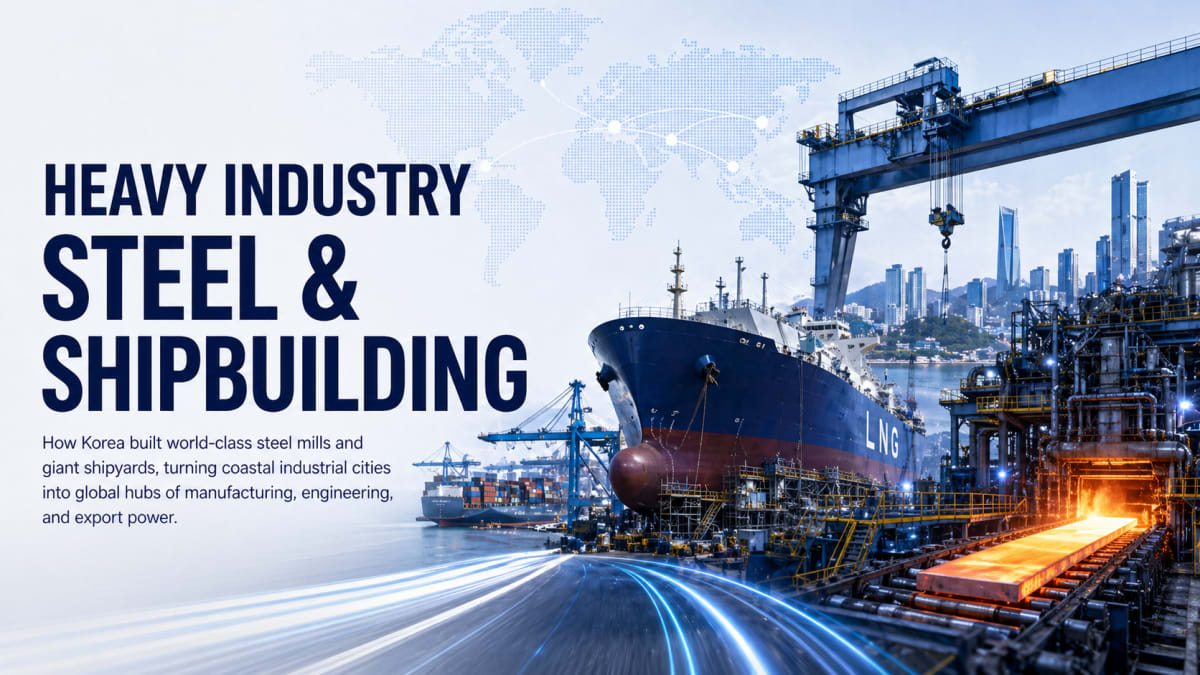
In the early 1970s, Korea had no significant steel production capacity and no modern shipbuilding industry. By 1980, it was a major steel producer. By 1990, it was the world's second-largest shipbuilder. By 2000, it was number one. The story of how Korea built these industries from nothing — on tidal flats, in record time, with borrowed technology and borrowed money — is one of the most concentrated examples of industrial development in economic history.
철강 (Steel)
POSCO — 기적의 제철소 (The Miracle Steel Mill)
포항제철 (POSCO, formerly Pohang Iron and Steel Company) was founded in 1968 with a combination of Japanese war reparations funding, government direction, and the singular determination of its founding chairman 박태준 (Park Tae-joon).
The founding conditions were not favorable. Korea had no iron ore, no coking coal, no existing steel industry, and no engineers with integrated steelmaking experience. The World Bank refused to fund the project, concluding that Korea lacked the preconditions for a viable steel industry.
박태준 proceeded anyway. The 포항 제1고로 (Pohang No. 1 Blast Furnace) began production in 1973 — ahead of schedule and under budget. By the 1980s, POSCO was operating one of the most efficient integrated steel mills in the world. By 2023, it was the world's 6th largest steel producer by crude steel output.
POSCO의 경쟁력 (POSCO's competitive advantage):
Consistently ranked among the world's most competitive steel companies by WSD (World Steel Dynamics)
Specialization in high-value steel products — automotive steel, electrical steel for motors, stainless steel
포스코 포항 제철소 is the world's largest single-site integrated steel mill by production capacity
철강 산업 개요 (Steel Industry Overview)
지표 (Metric) | 수치 (Figure) |
|---|---|
조강 생산량 순위 (Crude steel production rank) | 세계 6위 (POSCO 기준) |
한국 전체 철강 수출 순위 (Korea steel export rank) | 세계 5위 |
철강 수출 비중 (Steel export share) | 한국 전체 수출의 약 4% |
POSCO 주요 공장 (POSCO major plants) | 포항 (Pohang) + 광양 (Gwangyang) |
현대제철 (Hyundai Steel) — the steelmaking arm of the Hyundai group — is Korea's second-largest steel producer, specializing in automotive steel supplied directly to Hyundai and Kia's manufacturing operations.
Tip — 세계은행의 오판 (The World Bank's miscalculation): The World Bank's 1969 refusal to fund POSCO — on the grounds that Korea lacked the conditions for viable steel production — is frequently cited in development economics as one of the most consequential analytical errors in the institution's history. POSCO became not just viable but world-class within a decade. The case is used in academic discussions of whether standard development economics models can accurately assess the potential of state-directed industrialization.
조선 (Shipbuilding)
세계 1위 — 수주잔량 기준 (World Number One — By Order Backlog)
South Korea is the world's 1st or 2nd largest shipbuilder in any given year — competing closely with China — and consistently holds the largest order backlog globally. Korea's strength is not in volume but in value: Korean yards dominate the high-complexity, high-value segments of global shipping.
글로벌 조선 시장 점유율 (Global shipbuilding market share, 2023, by order value):
국가 (Country) | 점유율 (Share) |
|---|---|
한국 (Korea) | 약 43% |
중국 (China) | 약 48% |
일본 (Japan) | 약 7% |
By CGT (Compensated Gross Tonnage — a measure that weights complex ships more heavily), Korea's position is stronger than raw tonnage figures suggest.
3대 조선사 (The Big Three Shipbuilders)
HD현대중공업 (HD Hyundai Heavy Industries):
World's largest shipbuilder by revenue
Located in 울산 (Ulsan) — built on a tidal flat that was bare land when construction began in 1972
Capable of building virtually every ship type: LNG carriers, container ships, oil tankers, naval vessels
삼성중공업 (Samsung Heavy Industries):
Located in 거제 (Geoje)
Specialization in LNG carriers and offshore platforms
One of the world's leading producers of FLNG (Floating Liquefied Natural Gas) vessels
한화오션 (Hanwha Ocean, formerly Daewoo Shipbuilding):
Located in 거제 (Geoje)
Acquired by 한화그룹 (Hanwha Group) in 2023 following years of financial difficulty
Specialization in submarines and naval vessels — significant defense business alongside commercial shipbuilding
LNG 운반선 — 한국의 독보적 영역 (LNG Carriers — Korea's Uncontested Domain)
Korea's most significant competitive advantage in shipbuilding is LNG (Liquefied Natural Gas) carriers — the highly complex vessels that transport natural gas cooled to -163°C in cryogenic tanks.
LNG 운반선 지표 (LNG carrier metric) | 수치 (Figure) |
|---|---|
한국의 글로벌 LNG 운반선 점유율 (Korea's global LNG carrier share) | 약 75–80% |
LNG 운반선 1척 가격 (Price per vessel) | 약 $2.5억 (250 million USD) |
세계 LNG 운반선 발주 (Recent global LNG carrier orders) | Korea wins the overwhelming majority |
The technology barrier for LNG carriers is extremely high — the cryogenic containment systems, propulsion technology, and quality control requirements eliminate most competitors. China has been attempting to enter this segment for years; as of 2024, Korean yards maintain dominance.
현대중공업의 탄생 (How Hyundai Heavy Industries Was Born)
The story of how 현대중공업 was founded is one of the most audacious in Korean industrial history. In 1972, 정주영 (Chung Ju-yung) — the founder of Hyundai — approached a Greek shipping magnate for a ship order. He had no shipyard. He showed the Greek businessman a 500-won banknote with the 거북선 (turtle ship) on it, saying Korea had been building ships since the 16th century.
He secured the order. Then he built the shipyard — simultaneously constructing the yard and the ships it had been contracted to deliver. The first two ships were launched in 1974, before the yard itself was fully complete.
Key Facts
POSCO 설립 (POSCO founded) | 1968 — World Bank refused to fund it; became world-class within a decade |
POSCO 세계 순위 (POSCO global rank) | 6th largest steel producer globally by crude steel output (2023) |
한국 철강 수출 (Korea steel exports) | 5th largest steel exporter globally; approximately 4% of total Korean exports |
조선 수주 점유율 (Shipbuilding order share) | Korea holds approximately 43% of global shipbuilding orders by value (2023) |
LNG 운반선 점유율 (LNG carrier share) | Korea builds approximately 75–80% of the world's LNG carriers |
LNG 운반선 가격 (LNG carrier price) | Approximately $250 million per vessel — highest value commercial ship type |
3대 조선사 (Big Three yards) | HD현대중공업 (울산) / 삼성중공업 (거제) / 한화오션 (거제) |
현대중공업 설립 (HHI founding) | 1972 — shipyard and first ships built simultaneously; first delivery 1974 |
Comments
Inappropriate comments may be deleted.
Log in to leave a comment.
No comments yet. Be the first!