
Housing (주거): Monthly Rent, Jeonse & Officetel
Korean housing has its own vocabulary — and one system so unusual that it has no equivalent anywhere else in the world.
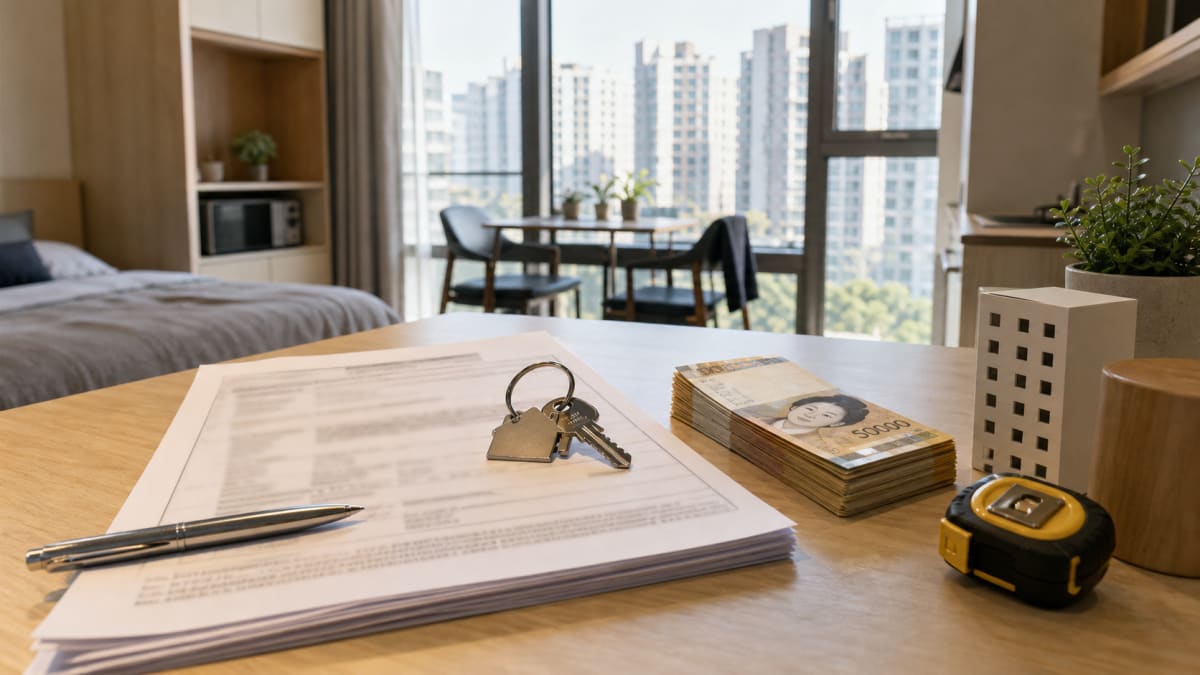
Finding a place to live in Korea is manageable. Understanding what you're signing up for before you sign anything is essential. Korean housing comes with terminology, deposit structures, and lease arrangements that are unlike anywhere else — and the most important one, 전세 (jeonse), is so counterintuitive that most foreigners encounter it for the first time with genuine disbelief.
This article explains the systems. The next one covers how to find and secure an apartment.
한국 주거 유형 (Types of Korean Housing)
아파트 (Apartment)
아파트 (apateu) are the dominant housing type in Korea — large residential towers, typically 15–30+ floors, organized into complexes called 단지 (danji). Approximately 50% of Korean households live in apartments.
Korean apartments are built to standardized sizes measured in 평 (pyeong) — one pyeong equals approximately 3.3 square meters. Common sizes: 20평 (66㎡), 30평 (99㎡), 40평 (132㎡).
장점 (Advantages): Security, maintenance services, parking, community facilities (some complexes have gyms, parks, and playgrounds). Well-insulated, generally well-maintained.
외국인에게 (For foreigners): Landlords in certain apartment complexes may be reluctant to rent to foreigners — particularly to those without Korean-speaking intermediaries. This varies significantly by complex and landlord.
오피스텔 (Officetel)
오피스텔 (officetel) — a portmanteau of "office" and "hotel" — is a Korean-specific building type combining residential and commercial use in a single structure. Units are smaller than standard apartments but fully equipped: kitchen, bathroom, built-in furniture often included.
외국인에게 (For foreigners): Officetels are typically more foreigner-friendly than apartment complexes. Landlords are accustomed to short-term leases and foreign tenants. The all-in setup (often including appliances) reduces the initial cost and hassle of setup.
위치 (Location): Concentrated in commercial and business districts — useful if you want walkable access to transit and amenities.
빌라 (Villa) / 연립주택 (Multi-family Housing)
빌라 in Korean does not mean a luxury property. It refers to low-rise multi-family buildings, typically 4 floors or fewer — older housing stock, frequently found in established neighborhoods. Rents are generally lower than apartments or officetels of comparable size.
주의사항 (Caution): Older villa buildings can have insulation, heating, and moisture issues. Inspect carefully before signing.
고시원 (Gosiwon)
고시원 — originally study rooms for civil service exam candidates — are small, furnished single rooms in shared-facility buildings. Bathroom and kitchen are typically shared. Monthly costs are very low (₩300,000–₩600,000) and contracts are month-to-month.
대상 (Who uses them): Recent arrivals, students, people between leases, those on very tight budgets. Not comfortable long-term for most foreigners but useful as a landing point.
임대 방식 (Rental Systems)
This is where Korean housing becomes genuinely distinctive.
월세 (Wolse — Monthly Rent)
월세 (wolse) is monthly rent — the system most foreigners are familiar with. You pay a deposit (보증금, bojeuggeum) upfront and then a fixed monthly payment.
Typical deposit structure: ₩1,000만–₩5,000만 (approximately $7,500–$37,500) as a security deposit, plus monthly rent.
The deposit is returned when you leave, assuming no damage. The larger the deposit, the lower the monthly rent — Korean landlords treat the deposit as a form of interest-free loan, and the two are inversely related.
Example:
보증금 ₩1,000만 + 월세 ₩80만 (small officetel, outer Seoul)
보증금 ₩3,000만 + 월세 ₩50만 (same unit — larger deposit, lower monthly)
전세 (Jeonse — Lump-Sum Deposit)
전세 (jeonse) is the system that has no equivalent anywhere else in the world. Instead of paying monthly rent, you pay a large lump-sum deposit — typically 60–80% of the property's market value — which the landlord holds for the duration of the lease (usually 2 years). At the end of the lease, the full deposit is returned to you. You pay no monthly rent during the lease period.
How the landlord benefits: The landlord invests the deposit — historically earning returns higher than the deposit amount from real estate appreciation or financial products. For decades, this worked: Korean property prices rose consistently, making jeonse a rational system for both parties.
The risks (which became very real in 2022–2023): When property prices fall and interest rates rise, landlords may be unable to return deposits — they have already spent or invested the money. The 전세 사기 (jeonse fraud/scam) crisis of 2022–2023 left thousands of tenants unable to recover their deposits when overleveraged landlords defaulted. The government introduced new protections, but the risk is real and requires due diligence.
Tip — 전세 보증보험 (Jeonse deposit insurance): The 주택도시보증공사 (HUG, Korea Housing and Urban Guarantee Corporation) offers 전세보증보험 (jeonse deposit insurance) — a product that guarantees deposit return if the landlord defaults. For any jeonse arrangement, this insurance is strongly recommended. Premium is modest relative to the deposit amount. Check eligibility on the HUG website (khug.or.kr).
반전세 (Ban-jeonse — Hybrid)
반전세 (ban-jeonse) — literally "half-jeonse" — sits between 월세 and 전세. A large deposit (smaller than full 전세) is combined with a reduced monthly payment. Common as market conditions shift between the two extremes.
임대 비용 현실 (The Reality of Rental Costs)
Costs vary dramatically by location. 서울 (Seoul) is significantly more expensive than other cities. Within Seoul, 강남구 (Gangnam-gu) and 서초구 (Seocho-gu) are the most expensive districts; outer districts like 노원구 (Nowon-gu) or 도봉구 (Dobong-gu) are considerably more affordable.
2024년 기준 월세 시세 (Approximate monthly rent, 2024):
지역·유형 (Location & Type) | 보증금 (Deposit) | 월세 (Monthly) |
|---|---|---|
서울 강남 오피스텔 (20평) | ₩3,000만–₩5,000만 | ₩120만–₩180만 |
서울 외곽 오피스텔 (20평) | ₩1,000만–₩3,000만 | ₩60만–₩100만 |
부산 아파트 (25평) | ₩2,000만–₩5,000만 | ₩60만–₩100만 |
대전·대구·광주 아파트 (25평) | ₩1,000만–₩3,000만 | ₩40만–₩80만 |
관리비 (Management Fee)
관리비 (gwanlibi, management fee) is a monthly charge separate from rent — covering building maintenance, common area cleaning, security, elevator operation, and sometimes utilities. For apartments, this typically ranges from ₩10만–₩30만 per month depending on building size and services. For officetels, management fees may include water and internet.
Always ask what is included in the management fee before signing. Utility bills (electricity, gas) may be separate.
난방 방식 (Heating System)
Korean homes use 온돌 (ondol) — underfloor heating, in which warm water pipes run beneath the floor. This is distinctly Korean and very effective: the floor itself is the radiator, creating warm, even heat from below. Most Koreans sleep on the floor (on thin mattresses called 요, yo) precisely because the floor is the warmest surface.
Modern apartments use district heating (지역난방) or individual gas boilers (개별 난방). Heating costs in winter — particularly in older buildings — can be significant. Ask about the heating system and typical winter utility costs before signing.
Key Facts
주요 주거 유형 (Main housing types) | 아파트 (apartment), 오피스텔 (officetel), 빌라 (villa), 고시원 (gosiwon) |
아파트 비율 (Apartment share) | Approximately 50% of Korean households live in apartments |
면적 단위 (Area unit) | 평 (pyeong) — 1 pyeong = approximately 3.3㎡ |
월세 (Wolse) | Monthly rent system — deposit (보증금) + monthly payment |
전세 (Jeonse) | Lump-sum deposit (60–80% of property value); no monthly rent; returned after lease (typically 2 years) |
전세 보증보험 (Jeonse insurance) | Available through 주택도시보증공사 (HUG) — strongly recommended for all jeonse arrangements |
관리비 (Management fee) | Monthly building maintenance charge — separate from rent; ₩10만–₩30만 typical |
난방 (Heating) | 온돌 (ondol) underfloor heating — standard in Korean homes |
임대차 기간 (Standard lease term) | 2 years (전세) or 1 year (월세) — with renewal rights under Korean tenancy law |
Comments
Inappropriate comments may be deleted.
Log in to leave a comment.
No comments yet. Be the first!