
What Is Korea? (한국 소개): A Beginner's Complete Overview
Everything you need to know before you dive in — the country, the name, and why the world is paying attention.
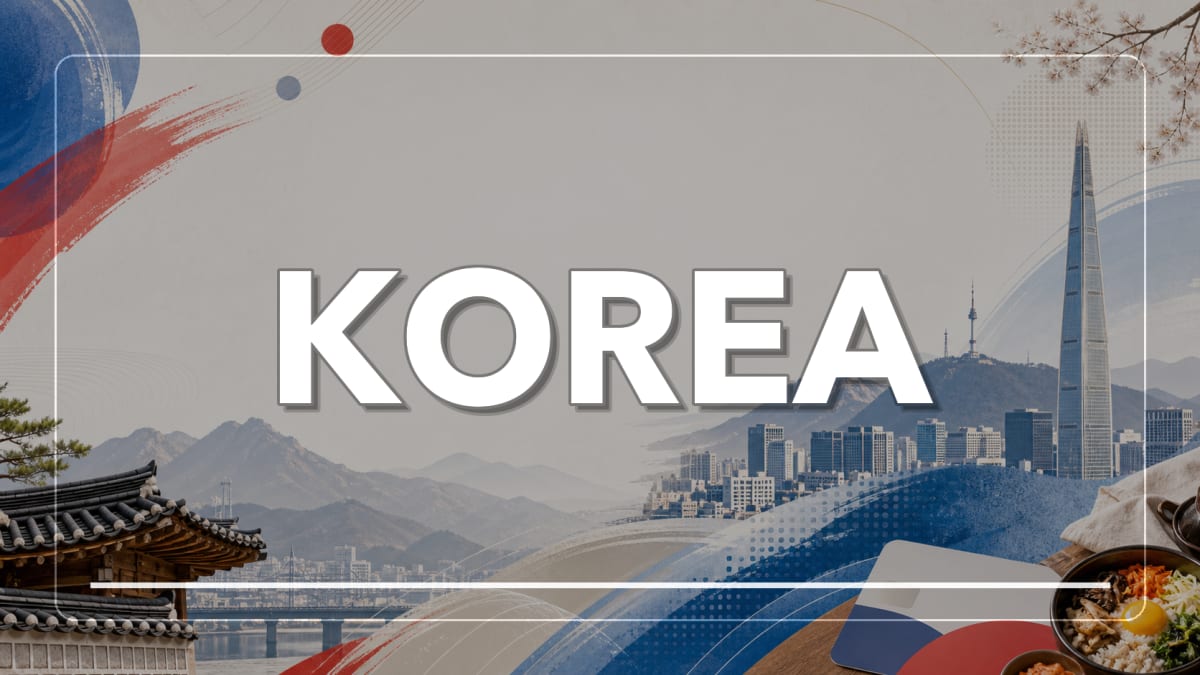
The country that gave the world BTS, Parasite, kimchi, and the world's fastest internet infrastructure is smaller than the state of Indiana. It shares a peninsula with one of the most isolated regimes on earth. And it went from one of the poorest countries in the world to one of the wealthiest in a single generation.
That's Korea — and there's a lot more where that came from.
Two Names, One Country
Here's something that trips up almost everyone encountering Korea for the first time: the country has two completely different names depending on who's speaking.
Korea — the name used in English — traces back to the Goryeo dynasty (918–1392 CE), which was well-known to Arab and Persian traders who brought the name westward. It eventually reached European languages and stuck.
한국 (Han-guk) — the name Koreans use for their own country — comes from the Han people of the Korean peninsula and guk (국), meaning nation or country. When Koreans refer to their own language, food, or culture, they use Han-guk: 한국어 (Han-guk-eo, Korean language), 한국 음식 (Han-guk eum-sik, Korean food).
You'll also encounter 조선 (Joseon) — the name of the dynasty that preceded modern Korea (1392–1897) and the name North Korea uses for the peninsula today.
Tip — Why this matters: If you're learning Korean or spending time with Korean people, using Han-guk instead of "Korea" immediately signals that you've done your homework. It's a small thing that goes a long way.
The Basics
Official name | Republic of Korea (대한민국, Dae-han-min-guk) |
Capital | Seoul (서울) — population ~10 million city proper, ~26 million metro area |
Population | ~51 million |
Size | 100,363 km² (about the size of Indiana, or slightly larger than Hungary) |
Language | Korean (한국어) |
Currency | Korean Won (₩ / KRW) |
Government | Presidential republic |
Time zone | KST (UTC+9) — same as Japan |
Where Is Korea?
Korea occupies the southern half of a peninsula that juts southward from northeastern China, with the Yellow Sea to the west and the Sea of Japan (East Sea) to the east. Japan lies about 200km to the southeast, China to the west, and Russia touches the far northeast corner of the peninsula.
The country is divided at the 38th parallel by the Demilitarized Zone (DMZ) — one of the most heavily fortified borders in the world — separating South Korea from North Korea. When people say "Korea" in everyday conversation, they almost always mean South Korea, the Republic of Korea.
The geography in brief:
Mountains cover about 70% of the land, concentrated in the east
Most major cities and agricultural land sit in the flatter western and southern regions
The coastline is irregular and dotted with thousands of small islands — Jeju Island being the largest and most visited
Four distinct seasons: hot and humid summers, cold and dry winters, brief but spectacular spring and autumn
A Country of Extremes
Korea's story is defined by contrast.
Speed and pressure. South Korea industrialized at a pace that has no parallel in modern history — from rubble after the Korean War (1950–1953) to a top-15 global economy in roughly 50 years. That same urgency is embedded in daily life: 빨리빨리 (ppalli-ppalli), meaning "hurry, hurry," is practically a national operating mode.
Ancient and ultramodern, side by side. A 600-year-old palace sits in the middle of Seoul, surrounded by skyscrapers. Buddhist temples share mountainsides with hiking trails packed on weekends. A culture that has existed for thousands of years runs on the world's fastest internet.
Globally influential, geographically small. A country of 51 million people has produced cultural exports — K-Pop, K-Drama, Korean cinema, Korean food — that have reshaped global entertainment. The scale of Korea's cultural reach is wildly disproportionate to its size.
Divided. The two Koreas share a language, history, and people, but have been politically and physically separated since 1945. The contrast between South Korea's dynamic modernity and North Korea's extreme isolation is one of the most striking geopolitical realities in the world today.
Why the World Is Paying Attention
The short answer: Korean culture got very good at being very good.
Korean cinema had been winning awards at Cannes for years before Parasite swept the Academy Awards in 2020. Korean pop music had been building a global fanbase for over a decade before BTS became the first Korean act to top the Billboard Hot 100. Korean food — kimchi, bulgogi, tteokbokki — is now recognizable well beyond the Korean diaspora.
This isn't coincidence. Korea invested heavily and deliberately in its cultural industries from the late 1990s onward, following the Asian financial crisis. The result is sometimes called the Hallyu Wave (한류) — the Korean Wave — a term for the global spread of Korean cultural products that shows no sign of slowing.
But what makes Korean culture compelling isn't just its production value. It's the culture underneath — a set of values, aesthetics, and ways of relating to other people that feel genuinely different from Western norms and genuinely interesting to understand.
Tip — K-Culture is a door, not a destination: If you arrived here through K-Pop or K-Drama, that's a great starting point — but there's a much richer country behind those entry points. The language, the history, the social dynamics, the food culture — Know Korea is built to take you there.
What This Site Covers
Know Korea is organized around 15 categories, grouped into five areas:
[한국 입문] Getting Started
Language and this Start Here section — the foundations for everything else.
[K-Culture] The Cultural Exports
K-Pop, K-Film, K-Drama, K-Sports, and K-Lifestyle — deep dives into the cultural phenomena that brought most of us here.
[한국 이해] Understanding Korea
Culture & Society, History & Politics, and Korea in the World — the context that makes the culture make sense.
[한국 생활] Living in Korea
Living in Korea, Work & Business, and Economy & Money — practical guides for people navigating life in Korea.
[여행/도구] Travel & Tools
Travel & Places and Tools & Resources — getting around and getting things done.
You don't need to read in order. Start where your curiosity is.
Help keep this content free for everyone.
Comments (3)
Inappropriate comments may be deleted.
Log in to leave a comment.

댓글
아이디를 poisian7 에서 poisian777로 변경했는데 댓글을 달면 poisian7로 표시가 된다. 단, refresh하면 정상 표시됨

fds afds