
The King and the Clown (왕의 남자)
Two street performers, a dangerous king, and a question about whether art can speak truth to power.
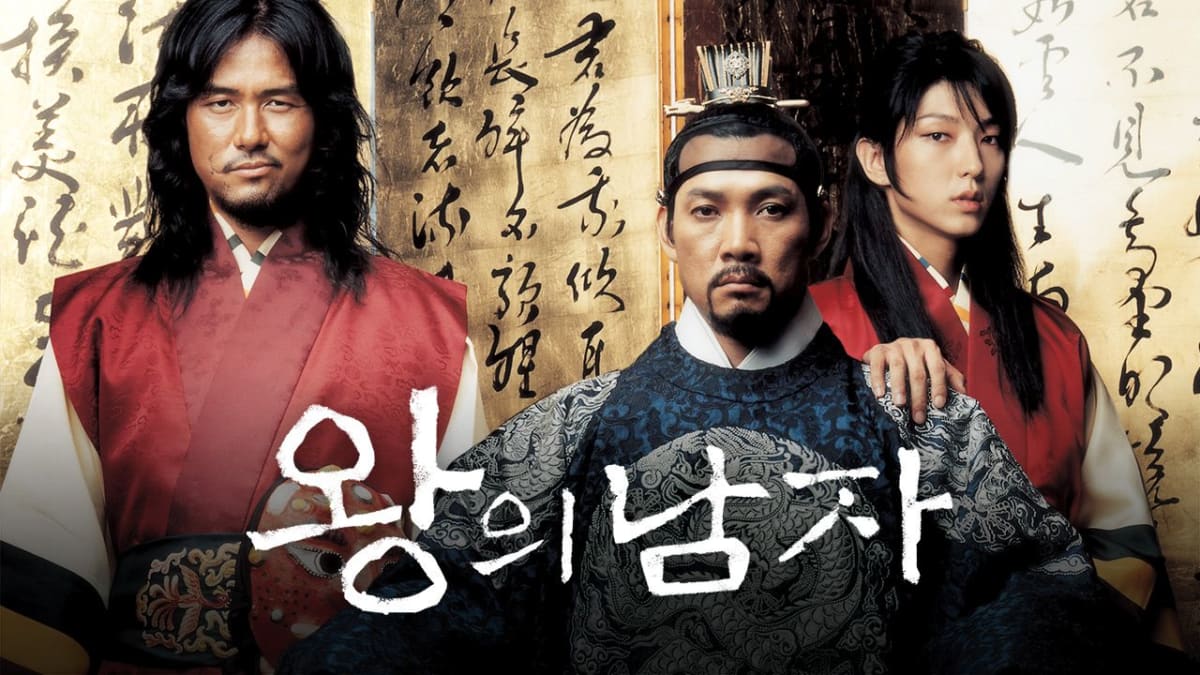
In 2005, 왕의 남자 became the highest-grossing Korean film of its year with 12.3 million admissions — at the time, among the top five highest-grossing Korean films of all time. It achieved this not through action spectacle or romantic formula, but through a period drama built around street performers, court satire, and a relationship between two men that the film treats with unusual delicacy. It is one of the most beloved Korean films of the 2000s, and one of the most interesting.
What the Film Is
Two itinerant performers — 장생 (Jang-saeng) and 공길 (Gong-gil) — travel 조선 (Joseon) making their living with troupes of street entertainers. 공길, whose appearance is feminine and whose performance specializes in female roles, attracts unwanted attention from the troupe's owner. 장생, who is protective of 공길, takes them both away and they form their own duo.
They arrive in 한양 (Hanyang, present-day Seoul) and perform a satirical play mocking 연산군 (King Yeonsan-gun) — an erratic, cruel, and historically documented ruler of the early 조선 period. They are arrested and brought before the court: if the king laughs, they live; if he doesn't, they die.
He laughs. And so begins their life at court — performing increasingly dangerous satire for an increasingly unstable king who takes a particular interest in 공길.
The Cast
Actor | Character |
|---|---|
감우성 (Kam Woo-sung) | 장생 — the protector, the straight performer |
이준기 (Lee Joon-gi) | 공길 — the beautiful performer, feminine in appearance |
정진영 (Jung Jin-young) | 연산군 — historically documented ruler |
이준기's performance as 공길 became a cultural phenomenon — his appearance in the role (androgynous, ethereal, performed with complete commitment) launched him to stardom and produced a level of audience response that the film's producers hadn't anticipated.
The Historical Context
연산군 (r. 1494–1506) is one of the most notorious figures in 조선 역사 (Joseon history) — documented in 실록 (Annals) as tyrannical, erratic, and responsible for mass purges of scholars and officials. He was eventually deposed by a palace coup.
The period setting is accurate in its material culture — 의상 (costumes), performance traditions, court hierarchies — while using the historical moment as a lens for examining questions about art, power, and truth that aren't specific to the 조선 period.
What the Film Is About
The political argument. The film asks a question with no clean answer: can art speak truth to power without being destroyed by power? The performers' satire names what the court doesn't say — the king's incompetence, the corruption, the fear everyone lives with. The king laughs. But is he laughing because he's been reached, or because he's above accountability?
The relationship between 장생 and 공길. The film handles this with a restraint that was unusual in Korean cinema at the time — the relationship is not explicitly romantic in dialogue or plot, but the emotional reality of it is present in every scene between them. 장생's protectiveness, his jealousy of the king's attention to 공길, his choices — these make sense in multiple ways simultaneously.
Beauty as vulnerability. 공길's ability to perform 여성성 (femininity) is the source of his art and the source of his danger. The film is quietly interested in what it means to be beautiful in contexts that want to use rather than protect beauty.
Tip — 외줄타기 피날레: The film's final sequence is one of Korean cinema's most visually memorable. It's worth knowing going in that the ending is not conventional, and that its emotional register is closer to tragedy than to resolution.
Why It Matters
Commercial significance. 12.3 million admissions in a country of 48 million — demonstrated that Korean audiences would turn out in extraordinary numbers for a period film of emotional and artistic ambition.
Cultural significance. 이준기's performance opened a conversation about gender performance, aesthetic beauty, and identity in Korean popular culture that was genuinely new. The film's ambiguity about the relationship between its two leads was a form of representation that Korean cinema hadn't offered with this degree of seriousness.
Historical significance. The use of 풍자 (court satire) — art that risks death to tell truth — produces an allegory about artistic freedom and institutional power that resonates beyond the 조선 setting.
Key Facts
Director | 이준익 (Lee Joon-ik) |
Year | 2005 |
Runtime | 119 minutes |
Language | Korean (조선 period language) |
Setting | 조선 왕조, early 16th century |
Domestic admissions | 12.3 million |
Comments
Inappropriate comments may be deleted.
Log in to leave a comment.
No comments yet. Be the first!