
Jjimjilbang (찜질방): Beloved Bathhouse Culture
First-timers often get a quiet shock: lying on the floor next to strangers in a gender-mixed space, eating roasted eggs, watching TV. And discovering that this is completely normal.
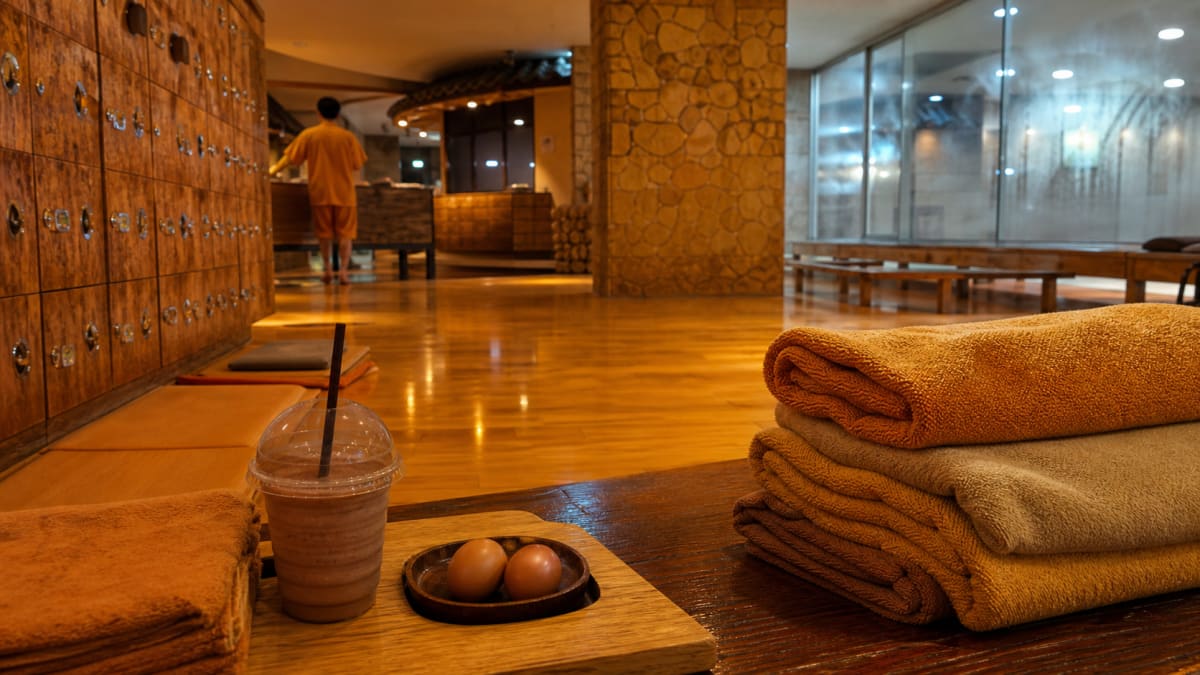
찜질방 (jjimjilbang) cannot be adequately described by its component parts — sauna, bathhouse, heated rooms, food court, sleeping area — because what makes it Korean is the combination and the cultural context around it. It is a shared space where 가족 (families), 연인 (couples), 친구들 (friends), and complete strangers coexist in a state of relaxed, sweaty equality. The dress code is provided cotton 짐질복 (jjimjilbok, uniform). The social pretension of the outside world does not enter.
찜질방의 구조 (Structure of a Jjimjilbang)
Most jjimjilbang are organized into two distinct zones:
목욕탕 (Mogyoktang): The Gender-Separated Bathing Area
The 목욕탕 (mogyoktang, bathing area) is gender-separated and entered naked — no swimsuit. This section contains:
탕 (hot pools): Various temperature options — 온탕 (warm), 열탕 (hot), 냉탕 (cold) — for soaking
샤워 시설 (shower facilities): For washing before and after soaking
사우나 (sauna): Dry and steam varieties
때밀이 (exfoliation scrub): An optional Italy towel scrub performed by professional technicians — one of the more distinctive Korean bathing traditions. They remove dead skin cells aggressively and efficiently. First-timers are often shocked by how much 때 (dead skin) comes off
찜질 공간 (Jjimjil Area): The Communal Space
After bathing, guests change into the provided 짐질복 (jjimjilbok) — cotton shorts and t-shirt sets, typically in 분홍 (pink) and 파란색 (blue) — and enter the communal heated rooms area. This section is gender-mixed and open to all.
방의 종류 (Types of heated rooms):
방 이름 (Room name) | 온도 (Temperature) | 특징 (Character) |
|---|---|---|
황토방 (Hwangto bang) | ~50°C | Clay walls; the most common room type |
소금방 (Sogeum bang) | ~45°C | Salt crystals — believed to benefit the skin |
맥반석방 (Maekbanseok bang) | ~55°C | Golden stone — emits far-infrared rays |
얼음방 (Eoreum bang) | ~5°C | Cooling room — used in alternation with hot rooms |
숯방 (Sut bang) | ~45°C | Charcoal — air purification effect |
The hot and cold rooms are typically used in alternation — a practice that parallels Nordic sauna culture and is believed to improve 혈액순환 (circulation).
먹거리 (Food at Jjimjilbang)
Jjimjilbang food is inseparable from the experience. The two iconic items:
구운 달걀 (Guun Dalgyal — Roasted Eggs): Eggs roasted in the heat of the 황토방 (clay room) until the shells turn brownish and the whites caramelize slightly. Eaten with salt. Sold at the 매점 (snack counter) for ₩500–1,000 each. Eating roasted eggs in a jjimjilbang is practically a ritual — it's what you do.
식혜 (Sikhye): A traditional Korean sweet rice drink — slightly thick, lightly sweet, served cold. The sweet, cool contrast to the hot room makes 식혜 (sikhye) the most satisfying drink in the jjimjilbang context.
Beyond these staples: 라면 (ramen), 떡볶이 (tteokbokki), sandwiches, and various Korean food options are typically available from the food area. Many jjimjilbang have full kitchen facilities.
찜질방의 사회적 기능 (Social Function)
Jjimjilbang occupies a distinctive place in Korean society.
가족 공간 (Family space): One of the few shared leisure spaces that works for everyone from young children to the elderly — frequently used as a family outing destination.
24시간 운영 (24-hour operation): Many jjimjilbang operate around the clock, functioning as an overnight space for those who need it. Missing the last train, needing cheap accommodation while traveling, or finding it difficult to get home after drinking — sleeping on the jjimjilbang floor is entirely normal behavior. In this context, the jjimjilbang also functions as an informal guesthouse.
Tip — 찜질방 이용 요금 (Admission): Entry typically costs ₩10,000–15,000 per person, including basic use, towel, and 짐질복 (jjimjilbok). Exfoliation scrubs, massage, and private lockers are priced separately. Well-known Seoul locations include 드래곤힐스파 (Dragon Hill Spa) in Yongsan, 실로암 (Siloam) near Seoul Station, and 스파렉스 (Spa Lex) in Gangnam. Call ahead or check the app before visiting to confirm hours.
외국인을 위한 실전 가이드 (Practical Guide for Foreigners)
문신 정책 (Tattoo policy): Some jjimjilbang — particularly in the 목욕탕 (bathing area) — restrict entry for guests with visible tattoos. Policies vary by establishment; check before visiting.
비누와 샴푸 (Soap and shampoo): Basic toiletries are provided free or at low cost, but bringing your own is also fine.
락커 (Locker): You receive a locker key at entry for storing valuables — worn as a wristband throughout your visit.
영어 소통 (English communication): Basic English communication is possible at most jjimjilbang, but having Google Translate ready is helpful.
Key Facts
찜질방 구조 (Structure) | Gender-separated 목욕탕 (mogyoktang) + communal 찜질 공간 (jjimjil area) + food court and rest areas |
입장료 (Admission) | Typically ₩10,000–15,000 — includes basic use, towel, and 짐질복 (jjimjilbok) |
짐질복 (Jjimjilbok) | Cotton shorts and t-shirt set provided at entry — worn throughout the communal area |
황토방 (Hwangto bang) | The most common heated room — clay walls, approximately 50°C, far-infrared heat |
구운 달걀 (Roasted eggs) | The iconic jjimjilbang food — eggs roasted in clay room heat; ₩500–1,000 each |
식혜 (Sikhye) | Sweet rice drink served cold — the signature jjimjilbang beverage after the hot rooms |
24시간 운영 (24-hour operation) | Most jjimjilbang operate around the clock; overnight stays are common — informal guesthouse function |
때밀이 (Exfoliation scrub) | Professional dead skin removal service in the bathing area — optional, intense, and effective |
Comments
Inappropriate comments may be deleted.
Log in to leave a comment.
No comments yet. Be the first!