
Emotions in K-Drama (드라마 감정): Feelings You Can't Translate
*K-Drama teaches the emotional vocabulary no textbook includes — and it's unforgettable.*
K-Pop gives you words attached to music. K-Drama gives you words attached to people — faces, relationships, stakes, silence. When a character says 괜찮아 (it's okay) while clearly not being okay, you understand that word in a way a flashcard can never teach you.
This is what makes K-Drama uniquely powerful for language learning. You're not studying vocabulary in isolation. You're watching what happens before the word, during it, and after — the full emotional context that gives language its actual meaning.
What K-Drama & Film Teaches That Textbooks Don't
Language textbooks teach you correct sentences. K-Drama teaches you real ones — including:
What people actually say when they're hurt but pretending not to be
How tone of voice changes the meaning of the same word completely
What Koreans say in moments of silence, and what that silence means
The difference between what a character says and what they mean
The emotional register of K-Drama — particularly the tension between what's said and what's felt — is one of the richest classrooms for understanding how Korean actually works in relationships.
Core Emotional Expressions
These appear across dramas constantly. Grouped by emotional situation:
사랑과 그리움 — Love and Longing
Korean | Romanization | Meaning | Notes |
|---|---|---|---|
사랑해 | sa-rang-hae | I love you | Informal — said to someone close |
사랑합니다 | sa-rang-ham-ni-da | I love you | Formal — more weight, more occasion |
보고싶었어 | bo-go-si-peo-sseo | I missed you | Literally: "I wanted to see you" — past tense longing |
네가 필요해 | ne-ga pi-ryo-hae | I need you | Vulnerable, raw — appears in pivotal scenes |
곁에 있을게 | gyeo-te i-sseul-ge | I'll stay by your side | One of the most quietly powerful lines in K-Drama |
Tip — 사랑해 vs. 사랑합니다: The formal version is less common in romantic contexts — it carries more solemnity, like a declaration rather than an expression. When a character switches from the casual to the formal, something significant is usually happening. Listen for the register shift.
위로 — Comfort and Reassurance
These appear in the aftermath of hard scenes — the exhale after the crisis:
Korean | Romanization | Meaning |
|---|---|---|
괜찮아 / 괜찮아요 | gwaen-chan-a / gwaen-chan-a-yo | It's okay / Are you okay? |
다 잘될 거야 | da jal-doel geo-ya | Everything will work out |
걱정하지 마 | geok-jeong-ha-ji ma | Don't worry |
울지 마 | ul-ji ma | Don't cry |
혼자가 아니야 | hon-ja-ga a-ni-ya | You're not alone |
Tip — 괜찮아 does a lot of work: You'll hear 괜찮아 used as a question (Are you okay?), a reassurance (I'm fine), a deflection (Don't worry about it), and a quiet lie (I'm not okay but I'm saying I am). Context — and the actor's face — tells you which one it is. This word alone is a masterclass in the gap between language and meaning.
결심과 의지 — Determination and Will
K-Drama runs on characters who refuse to give up. This vocabulary shows up in the turning-point scenes:
Korean | Romanization | Meaning |
|---|---|---|
할 수 있어 | hal su i-sseo | I can do it / You can do it |
포기하지 마 | po-gi-ha-ji ma | Don't give up |
끝까지 갈게 | kkeut-kka-ji gal-ge | I'll go until the end |
두고 봐 | du-go bwa | Watch me / Just you wait |
반드시 | ban-deu-si | Without fail / I will absolutely... |
분노와 좌절 — Anger and Frustration
These tend to be short, sharp, and extremely common in dramatic confrontations:
Korean | Romanization | Meaning |
|---|---|---|
왜 그래? | wae geu-rae? | Why are you being like this? |
말도 안 돼 | mal-do an-dwae | That makes no sense / No way |
어떻게 그럴 수 있어? | eo-tteo-ke geu-reol su i-sseo? | How could you do that? |
됐어 | dwaet-sseo | Forget it / That's enough / I'm done |
짜증나 | jja-jeung-na | I'm so frustrated / This is annoying |
Tip — 됐어 is one of the most loaded words in K-Drama: On the surface it means "it's done" or "that's enough." But depending on delivery, it can mean: I'm giving up on this argument, I'm done with you, I'm fine (dismissively), or stop talking. Short words with wide ranges are worth paying close attention to.
두려움과 충격 — Fear and Shock
Korean | Romanization | Meaning |
|---|---|---|
어떡해 | eo-tteo-kae | What do I do / Oh no |
무서워 | mu-seo-wo | I'm scared |
설마 | seol-ma | Surely not... / Don't tell me... |
믿을 수 없어 | mi-deul su eop-seo | I can't believe it |
왜 나한테 이래? | wae na-han-te i-rae? | Why are you doing this to me? |
Shows Worth Studying — and What to Listen For
사랑의 불시착 (Crash Landing on You)
Best for: Comfort vocabulary, love expressions, formal and informal speech contrast
The central relationship crosses the North-South Korean divide, which means the show is unusually explicit about language — characters comment on how the other speaks. Pay attention to how the two leads shift between formal and informal speech as their relationship develops. The comfort vocabulary in this show — especially variations of 괜찮아 and 곁에 있을게 — is exceptional.
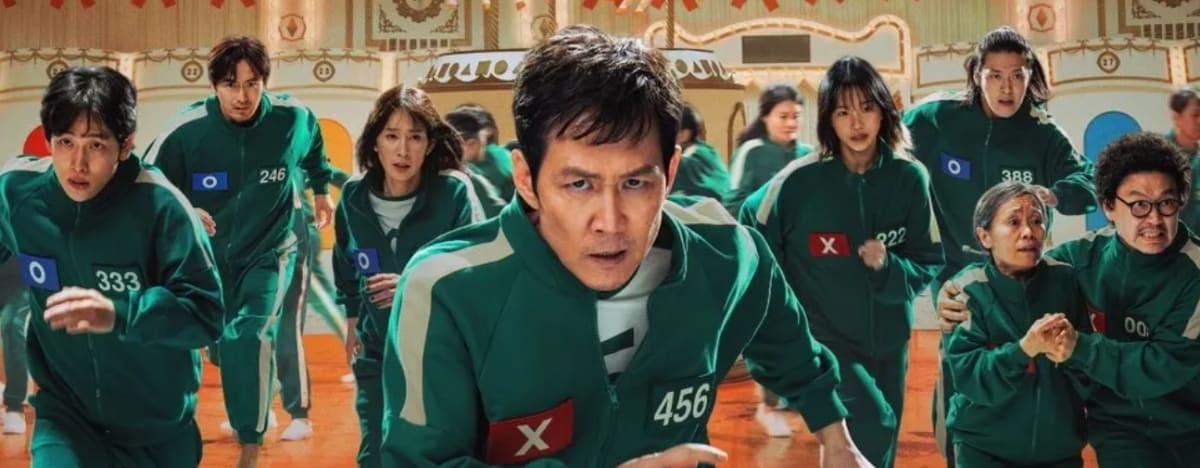
오징어 게임 (Squid Game)
Best for: Survival vocabulary, working-class speech, raw emotional honesty
The language here is rough, immediate, and real — not polished drama speech. Characters express desperation, betrayal, and solidarity in ways that feel unscripted. Also worth noting: 무궁화꽃이 피었습니다 (mu-gung-hwa-kko-chi pi-eot-seum-ni-da) — the children's game phrase used throughout — is a full sentence worth understanding. It means "the rose of Sharon has bloomed," and learning it gives you both a cultural reference and a mini grammar lesson.
도깨비 (Goblin)
Best for: Literary and poetic Korean, philosophical expressions, longing vocabulary
Goblin's dialogue is deliberately more literary than most dramas — longer sentences, metaphorical language, expressions about fate and time (운명, 기억, 영원). More challenging linguistically, but worth returning to once you have some vocabulary base. The longing expressed between the lead characters is some of the richest emotional Korean in any drama.
이태원 클라쓰 (Itaewon Class)
Best for: Determination vocabulary, workplace speech, short punchy expressions
The protagonist's speech is defined by short, firm declarations of intent. Excellent source for 할 수 있어, 포기하지 마, and 끝까지 — the determination vocabulary in this show is constant and clear.
응답하라 1988 (Reply 1988)
Best for: Warm everyday family language, neighborhood community speech, non-dramatic vocabulary
Most K-Drama learning focuses on intense emotional peaks. Reply 1988 is valuable because it shows everyday warmth — how Korean people talk at dinner tables, in hallways, between neighbors. The emotional register is quieter and closer to daily speech.
이상한 변호사 우영우 (Extraordinary Attorney Woo)
Best for: Clear, deliberate pronunciation; legal vocabulary; direct speech patterns
The protagonist speaks in a distinctive, precise way that's unusually easy to follow for learners. Good for building listening comprehension because the diction is clear and the sentence structures are often explicit.
How to Study a Scene
Unlike K-Pop where you study a whole song, K-Drama learning is most effective at the scene level — one 3–5 minute sequence at a time.
Step 1 — Watch without subtitles
Even if you understand nothing. Notice emotional tone, body language, and which words you recognize.
Step 2 — Watch with Korean subtitles
Most streaming platforms (Netflix, Viki) allow you to set both audio and subtitles to Korean. Reading along while hearing the words is the most effective combination.
Step 3 — Identify the emotional peak of the scene
What's the most charged moment? What word or phrase is at the center of it? That's your anchor vocabulary.
Step 4 — Replay that moment 3–5 times
Listen specifically for the pronunciation, the rhythm, the intonation. How does the actor's tone change the meaning?
Step 5 — Look up one unfamiliar word from the scene
Just one. Write it down with the context — not just the definition, but the moment it came from. Memory is tied to emotion; the scene is the memory hook.
Tip — Use the pause button without guilt: Fluent speakers don't pause. Learners should. Pause after every important line, repeat it out loud, and move on. Streaming makes this effortless — K-Drama is one of the few contexts where you have a legitimate reason to watch the same scene fifteen times.
The Silence Vocabulary
One thing K-Drama teaches that no article can fully convey: silence is part of the language.
Korean has a concept called 눈치 (nun-chi) — the ability to read a room, to sense what someone means without them saying it. K-Drama is built on this. Characters often say the opposite of what they feel, or say nothing at all and let silence carry the meaning.
When you see a character go quiet after being asked 괜찮아?, that silence is communicating as loudly as any word. When a character says 됐어 and walks away, the word and the exit together mean something different from either one alone.
This is the deepest level of K-Drama language learning — not vocabulary, but reading the emotional architecture of a scene. It takes time, and it happens slowly. But it's the thing that eventually makes Korean feel less like a foreign language and more like a second emotional language.
A Final Note on the Whole Series
You've now covered the full arc of this language section — from Hangul's building blocks to the emotional texture of K-Drama. The vocabulary in articles 08, 09, 10, and 11 lives at a different level from the earlier articles. It's not rules or systems; it's feeling.
The path from here is simple: keep consuming Korean content with attention. Every song, every drama, every fandom thread is adding to a vocabulary that's already larger than you think. The words from these articles will start appearing everywhere — not because you'll be looking for them, but because you'll have trained yourself to hear them.
Try It Right Now
Open any K-Drama episode — one you've seen before works perfectly. Find a scene with an emotional confrontation or a quiet moment between two characters.
Watch it once in English (or your native language).
Then watch it again in Korean audio with Korean subtitles.
Find one word from your list that appears. Just one. Notice how it sounds coming out of an actual person's mouth, in an actual moment, in actual Korean.
That word is yours now.
Comments
Inappropriate comments may be deleted.
Log in to leave a comment.
No comments yet. Be the first!