
Survival Korean (생존 한국어): Food, Shopping & Places
The essential words and phrases for eating, buying, and getting around in Korea.
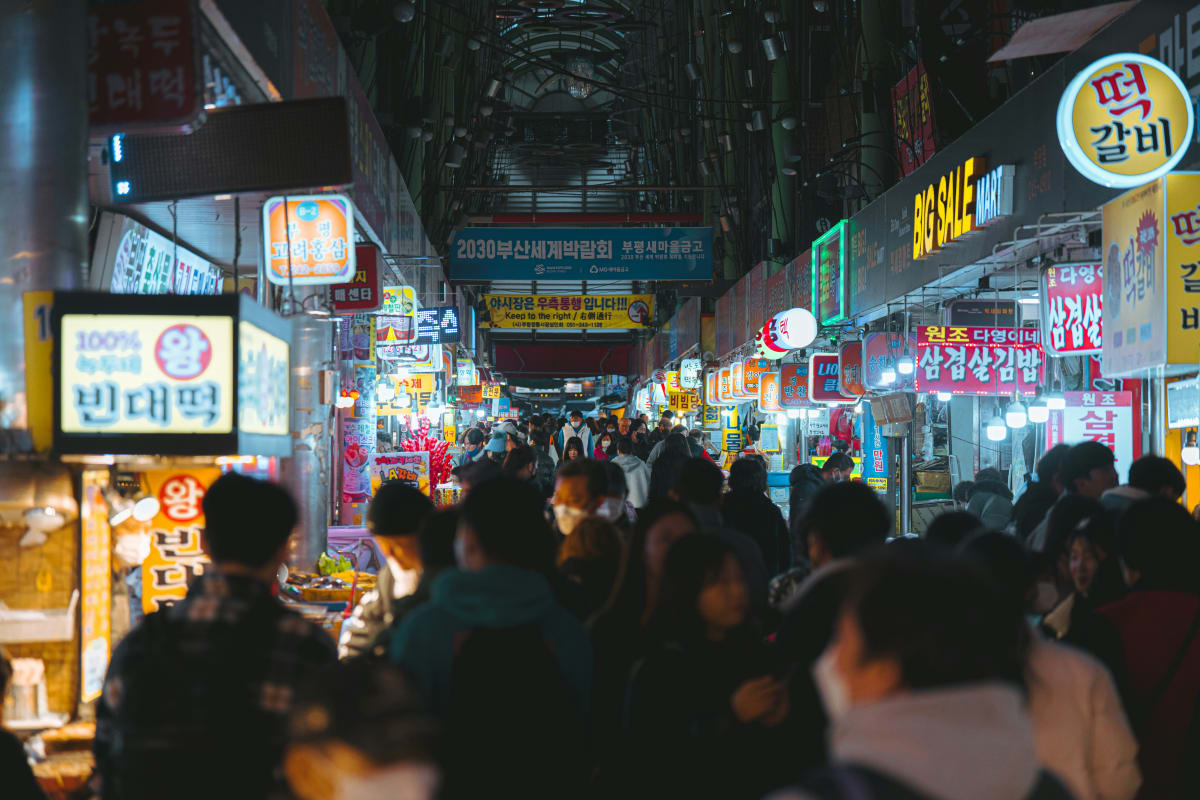
You don't need perfect Korean to have a great time in Korea. You need about 20 words, the willingness to point at things, and the confidence to try.
This article is a practical field guide for three situations you'll hit on any trip: sitting down to eat, browsing a market or shop, and finding your way around. The phrases here are short, high-frequency, and immediately useful.
Part 1 — Food: Cafés, Street Food & Restaurants
Ordering at a Café
Korea has more cafés per capita than almost any country in the world. Knowing your coffee order in Korean is genuinely useful from day one.
The menu will mostly look familiar — 아메리카노 (a-me-ri-ka-no), 카페라떼 (ka-pe-ra-tte), 그린티 라떼 (geu-rin-ti ra-tte). But two expressions separate you from every other tourist:
아아 (a-a) — Short for 아이스 아메리카노 (ice americano). Koreans say it constantly. Order it this way and you'll get a smile.
뜨아 (tteu-a) — Short for 따뜻한 아메리카노 (hot americano). Same idea.
To order anything: just say the item + 주세요 (ju-se-yo) — please give me this.
아아 주세요. (A-a ju-se-yo.) — One iced americano, please.
이거 주세요. (I-geo ju-se-yo.) — This one, please. [pointing at the menu]
Street Food You Should Know
분식 (bun-sik) — Korea's beloved category of quick, cheap, satisfying snacks. Found at street stalls, convenience stores, and small restaurants everywhere.
Korean | Romanization | What it is |
|---|---|---|
김밥 | Gim-bap | Rice and fillings rolled in seaweed — Korea's answer to an on-the-go meal |
떡볶이 | Tteok-bok-ki | Chewy rice cakes in spicy-sweet red sauce — the most popular street food in Korea |
라면 | Ra-myeon | Korean instant noodles — eaten at convenience stores, or boiled on the Han River |
순대 | Sun-dae | Korean blood sausage — an acquired taste, but a classic |
Tip — 컵라면 at a convenience store: Grab a 컵라면 (kup-ra-myeon — cup noodle), pay, and the staff will pour hot water for you. Eat at the counter or outside. This is not tourist food — it's what Koreans actually eat. The Han River version (봉지라면 / bong-ji ra-myeon cooked in a pot at the riverbank) is a bucket-list experience.
Restaurant Essentials
Phrase | Romanization | Use it when |
|---|---|---|
저기요! | Jeo-gi-yo | Calling a server — say it clearly, not timidly |
이거 얼마예요? | I-geo eol-ma-ye-yo | Asking the price |
이거 주세요 | I-geo ju-se-yo | I'll take this one |
맛있어요! | Ma-si-sseo-yo | This is delicious — use this generously |
물 주세요 | Mul ju-se-yo | Water, please |
계산해 주세요 | Gye-san-hae ju-se-yo | Check, please |
Key food words for reading menus:
Korean | Romanization | Meaning |
|---|---|---|
밥 | bap | Steamed rice — the center of Korean meals |
찌개 | jji-gae | Stew / hot pot |
김치찌개 | gim-chi-jji-gae | Kimchi stew — on every menu, always reliable |
된장찌개 | doen-jang-jji-gae | Fermented soybean paste stew — earthy and comforting |
비빔밥 | bi-bim-bap | Mixed rice bowl with vegetables and gochujang sauce |
불고기 | bul-go-gi | Sweet soy-marinated grilled beef — great for first-timers |
삼겹살 | sam-gyeop-sal | Grilled pork belly — Korea's most-loved social meal |
치킨 | chi-kin | Korean fried chicken — crispier than you've had before |
치맥 | chi-maek | Fried chicken + beer (맥주 / maek-ju) — a Korean cultural institution |
Tip — 매워요? (Is it spicy?): If spice is a concern, point at a dish and ask 매워요? (mae-wo-yo?). Staff will answer honestly. Alternatively, look for 순한 맛 (sun-han mat) on a menu — it means "mild flavor."
Part 2 — Shopping: Markets and Stores
Getting Started
Walk into any small shop or market stall and the owner will likely greet you. Respond with 안녕하세요 and you've already made a good impression.
To get someone's attention:
저기요! (Jeo-gi-yo!) — Excuse me / Hey there
사장님! (Sa-jang-nim!) — Literally "boss" — used warmly for any shop owner. It's friendly, not formal.
The Three Phrases That Cover Almost Everything
1. 이거 얼마예요? (I-geo eol-ma-ye-yo?) — How much is this?
Point at something and say this. That's it. The entire transaction can start here.
이거 (i-geo) — this (nearby)
저거 (jeo-geo) — that (further away)
2. 이거 주세요 (I-geo ju-se-yo) — I'll take this.
The buying decision, complete in four syllables.
3. 괜찮아요 (Gwaen-chan-a-yo) — It's okay / No thank you.
When you don't want something being offered, this is the polite exit. A small smile and 괜찮아요 is understood everywhere.
If It Feels Expensive
비싸요 (bi-ssa-yo) — It's expensive. (Said with a slightly regretful expression, this sometimes prompts a discount offer.)
깎아주세요 (kka-kka-ju-se-yo) — Please give me a discount.
Tip — Where bargaining works (and doesn't): 깎아주세요 is perfectly normal at traditional markets like Dongdaemun (동대문) or Namdaemun (남대문). At department stores, brand shops, or chain stores, prices are fixed — bargaining would be awkward. When in doubt, look for a price tag. If there isn't one, asking is fair game.
Part 3 — Getting Around: Places, Directions & Transport
Landmarks and Places Worth Knowing
Korean | Romanization | What it is |
|---|---|---|
강남 | Gang-nam | Seoul's modern, upscale district — K-Pop agencies, shopping, nightlife |
홍대 | Hong-dae | Young, artistic neighborhood — busking, indie shops, clubs |
이태원 | I-tae-won | International district — global food, diverse culture |
경복궁 | Gyeong-bok-gung | Joseon Dynasty palace — Seoul's most visited historical site |
제주도 | Je-ju-do | Korea's largest island — volcanic landscapes, beaches |
부산 | Bu-san | Second city — beaches, seafood, the Busan International Film Festival |
Place-building words:
Suffix | Romanization | Meaning | Example |
|---|---|---|---|
-역 | -yeok | Station | 강남역 Gang-nam-yeok |
-호선 | -ho-seon | Subway line | 2호선 i-ho-seon (Line 2) |
-궁 | -gung | Palace | 경복궁 Gyeong-bok-gung |
-시장 | -si-jang | Market | 남대문시장 Nam-dae-mun-si-jang |
공항 | gong-hang | Airport | 인천공항 In-cheon-gong-hang |
화장실 | hwa-jang-sil | Restroom | — |
Directions
Korean | Romanization | Meaning |
|---|---|---|
왼쪽 | oen-jjok | Left |
오른쪽 | o-reun-jjok | Right |
직진 | jik-jin | Straight ahead |
건너편 | geon-neo-pyeon | Across / opposite side |
Getting There
Korean | Romanization | Meaning |
|---|---|---|
지하철 | ji-ha-cheol | Subway |
버스 | beo-seu | Bus |
택시 | taek-si | Taxi |
The three most useful sentences:
실례합니다, [장소] 어디에 있어요?
Sil-lye-ham-ni-da, [place] eo-di-e i-sseo-yo?
Excuse me, where is [place]?이 주소로 가주세요.
I ju-so-ro ga-ju-se-yo.
Please take me to this address. (Show the address on your phone)여기서 내려요.
Yeo-gi-seo nae-ryeo-yo.
I'll get off here.
Tip — Save addresses in Korean: Korean taxi drivers and locals respond much better to a Korean-script address than an English transliteration. Before you leave, copy the Korean address of your hotel or destination into your phone's notes. Showing that screen alongside "이 주소로 가주세요" will get you there every time.
Your Survival Cheat Sheet
Situation | Korean | Romanization |
|---|---|---|
Get a server's attention | 저기요! | Jeo-gi-yo! |
Call a shop owner | 사장님! | Sa-jang-nim! |
How much is this? | 이거 얼마예요? | I-geo eol-ma-ye-yo? |
I'll take this | 이거 주세요 | I-geo ju-se-yo |
No thank you | 괜찮아요 | Gwaen-chan-a-yo |
It's expensive | 비싸요 | Bi-ssa-yo |
Discount, please | 깎아주세요 | Kka-kka-ju-se-yo |
This is delicious | 맛있어요! | Ma-si-sseo-yo! |
Water, please | 물 주세요 | Mul ju-se-yo |
Check, please | 계산해 주세요 | Gye-san-hae ju-se-yo |
Is it spicy? | 매워요? | Mae-wo-yo? |
Where is [place]? | [장소] 어디에 있어요? | [place] eo-di-e i-sseo-yo? |
Take me to this address | 이 주소로 가주세요 | I ju-so-ro ga-ju-se-yo |
I'll get off here | 여기서 내려요 | Yeo-gi-seo nae-ryeo-yo |
Restroom | 화장실 | Hwa-jang-sil |
Try It Right Now
Imagine you're in Hongdae on a Saturday afternoon. Walk through this sequence out loud:
Enter a café. The server looks up. → 안녕하세요.
Point at the menu board. → 아아 주세요.
Walk out and spot a market stall with something interesting. → 이거 얼마예요?
The price feels a bit high. → 비싸요... (pause, hopeful expression)
You decide to buy it anyway. → 이거 주세요. 감사합니다.
You need to find the subway. Ask a passer-by: → 실례합니다, 홍대입구역 어디에 있어요?
Six exchanges. Real Korean. Real situations. That's what survival Korean looks like in practice.
Comments
Inappropriate comments may be deleted.
Log in to leave a comment.
No comments yet. Be the first!