
Gyeongju (경주): Korea's Ancient Capital
Gyeongju was the capital of the Silla Kingdom for nearly 1,000 years. Most other cities carry their history in museums. Gyeongju carries it underfoot.
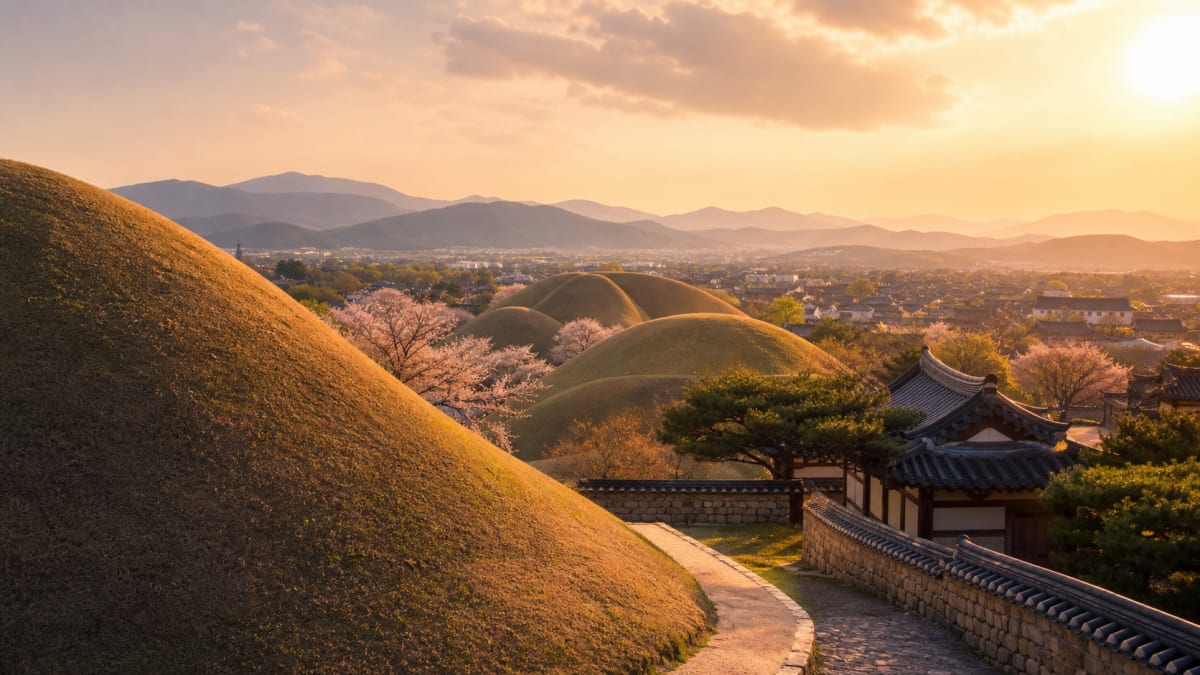
Construction workers in 경주 (Gyeongju) hit artifacts regularly. A new building's foundation breaks into a tomb. A road widening project uncovers palace stones. The city has no skyscrapers — not because of preference, but because building height restrictions protect a skyline under which the ground itself is an archive. Walk fifteen minutes in any direction from the city center and you will pass something that is over a thousand years old. Usually without a queue in front of it.
This is what makes Gyeongju different from every other historical destination in Korea. The history is not cordoned off. It is simply present, distributed across a living city, available to anyone who walks slowly enough to notice it.
신라의 수도 (Capital of Silla)
경주 was the capital of the 신라 (Silla) Kingdom from 57 BCE to 935 CE — nearly 1,000 years as a continuous seat of power. That is longer than Rome served as the capital of the Roman Empire. At its height in the eighth century, Silla's Gyeongju was among the largest cities in the world, with a population estimated close to 1 million — a scale of urban life almost impossible to imagine standing in the quiet modern city today.
Silla unified the Korean peninsula in 668 CE after defeating the rival kingdoms of Goguryeo and Baekje, ushering in the Unified Silla period — an era of cultural and artistic flowering that produced most of what survives in Gyeongju today. The Buddhist temples, the stone pagodas, the royal tombs, the observatory: all are products of a civilization at its peak, confident enough to build for permanence.
UNESCO has recognized the result. Gyeongju holds multiple World Heritage designations and was named one of the world's ten most important ancient cities. The designation understates the experience.
대릉원과 고분군 (Daereungwon and the Royal Tombs)
The first thing that stops visitors in their tracks is usually not a temple or a museum. It is 대릉원 (Daereungwon Tumulus Park) — a park containing 23 royal burial mounds from the Silla period, the largest rising 23 meters from the ground, enormous grass-covered earthen hills distributed across what is otherwise an ordinary city neighborhood.
There is nothing quite like walking among them at dusk or in early morning mist. The mounds are simultaneously simple and monumental — no carved stone, no inscription, just the curved weight of earth that has held royal remains for fifteen centuries while the city built itself around them.
천마총 (Cheonmachong Tomb) within the park allows interior access — the only royal tomb in Gyeongju you can enter. The burial chamber reconstruction shows the scale of Silla royal interment: a wooden coffin surrounded by thousands of grave goods, the deceased equipped for an afterlife at the same standard as their living one. The artifacts found here — including the 천마도 (Cheonmado), a painting of a flying white horse on birchbark, considered the oldest extant Korean painting — are in the 국립경주박물관 (Gyeongju National Museum). The originals are worth the separate visit.
불국사와 석굴암 (Bulguksa and Seokguram)
Built in 751 CE under the Unified Silla king Gyeongdeok, 불국사 (Bulguksa) is Korea's most celebrated Buddhist temple complex — and one of the few cases in Korean tourism where the reputation is not exaggerated.
What makes Bulguksa exceptional is not its scale but its precision. The stone stairways leading to the main hall — 청운교·백운교 (Cheongunggyo and Baegungyo, the Blue Cloud and White Cloud Bridges) — are among the finest surviving examples of Silla stone architecture: each step mathematically calculated, each joint fitted without mortar, the whole structure still standing without restoration after thirteen centuries. The two stone pagodas in the main courtyard — 다보탑 (Dabotap) and 석가탑 (Seokgatap) — are reproduced on the 10-won coin. Seeing the originals in the space they were designed for is a different experience entirely. UNESCO World Heritage Site.
20 minutes up the mountain behind Bulguksa, 석굴암 (Seokguram Grotto) is a man-made granite cave housing a seated Buddha figure considered the finest Buddhist sculpture surviving in East Asia. The grotto was engineered in the eighth century with a precision that continues to baffle structural historians — the dome construction, the humidity control achieved through natural ventilation, the positioning to face the sunrise over the East Sea. The Buddha itself radiates a quality of stillness that photographs fail to capture. UNESCO World Heritage Site.
Tip — 석굴암 방문 시각 (Best Time for Seokguram): The grotto faces east, toward the East Sea. On clear mornings — particularly around sunrise — the light enters at an angle that illuminates the Buddha in a way that changes the experience entirely. The last bus from Bulguksa to Seokguram departs early evening; plan accordingly.
첨성대와 월성 (Cheomseongdae and Wolseong)
Standing alone in an open field near the tumulus park, 첨성대 (Cheomseongdae Observatory) is one of those structures that rewards unhurried looking. Built in the seventh century during the reign of Queen 선덕여왕 (Seondeok) — one of three female rulers in Silla's history — it is the oldest surviving astronomical observatory in East Asia. The cylindrical stone tower stands 9.4 meters high, constructed from 362 stones in 27 layers — numbers that correspond to the days and weeks of the lunar calendar. It is not large. It is exact.
Adjacent is 월성 (Wolseong, or "Moon Fortress") — the site of the Silla royal palace, now a grassy earthen mound with ongoing archaeological excavation. The excavations, begun in earnest in 2016, have already produced extraordinary finds: roof tiles, ceremonial objects, and evidence of the palace's original scale. The site is partially open to observation.
동궁과 월지 (Donggung Palace and Wolji Pond)
동궁과 월지 (Donggung Palace and Wolji Pond) — historically known as 안압지 (Anapji) — is Gyeongju's most atmospheric evening destination. A reconstructed Silla palace complex surrounds an artificial pond, with pavilions reflected in still water and lit after dark in a way that produces the specific quality of beauty that the Silla court was cultivating when they built it.
The pond was constructed in 674 CE as a pleasure garden for the Silla royal family. When it was drained for excavation in the 1970s, over 33,000 artifacts were recovered from the mud — objects dropped, discarded, or deliberately placed over centuries of royal use. Many are now in the National Museum.
Visit in the evening. The daytime is pleasant; after dark, with the reflection of the illuminated pavilions in the water, it becomes something else.
황리단길 (Hwangnidan-gil)
Between the tumulus park and the railway station, 황리단길 (Hwangnidan-gil) has developed into Gyeongju's independent café and restaurant district — named, like Seoul's Gyeongnidan-gil, after the steep road it runs along. Old storefronts have been converted into coffee shops, 한복 (hanbok) rental places, and small restaurants serving Gyeongju's local specialties.
The street's particular quality comes from the combination: you can drink a good espresso while looking at a royal burial mound. The 한복 rental shops make sense here in a way they sometimes don't elsewhere — wearing traditional dress within sight of the tombs and observatory produces a different feeling than wearing it for photographs in front of a palace gate.
경주 교동법주 (Gyeongju Gyodong Beopju): The traditional rice wine of Gyeongju, designated an Intangible Cultural Heritage. Available in restaurants and shops along Hwangnidan-gil — sweeter and more complex than standard makgeolli. Worth trying in the city where it was made.
교통과 이동 (Getting There and Around)
서울에서 (From Seoul): KTX to 신경주역 (Singyeongju Station) — approximately 2h 10min, ₩43,500–₩50,500. From the station, bus or taxi to the city center takes 15 minutes. Some slower KTX services stop at 경주역 (Gyeongju Station), which is more central and walkable to Hwangnidan-gil and the tumulus park.
부산에서 (From Busan): 40–50 minutes by train or intercity bus — Gyeongju is a natural day trip from Busan and a logical overnight stop on a Seoul–Busan itinerary.
시내 이동 (Getting around): Gyeongju's historical sites are distributed across a flat area ideally suited to cycling. Bicycle rentals are available near Gyeongju Station and around Daereungwon. A route connecting Daereungwon → Cheomseongdae → Wolseong → Donggung and Wolji Pond → National Museum takes 3–4 hours at a relaxed pace. Bulguksa and Seokguram require a bus or taxi — approximately 30 minutes from the city center.
Key Facts
수도 기간 (Capital Period) | 57 BCE to 935 CE — nearly 1,000 years as continuous capital; Silla unified the Korean peninsula in 668 CE |
UNESCO 지정 (UNESCO) | Multiple World Heritage Sites — Bulguksa, Seokguram, historic districts; one of ten most important ancient cities globally |
대릉원 (Daereungwon) | 23 royal burial mounds — largest 23m high; 천마총 (Cheonmachong) open for interior access; 천마도 is the oldest extant Korean painting |
불국사 (Bulguksa) | Built 751 CE — 13 centuries standing without mortar; 다보탑·석가탑 pagodas on the 10-won coin |
첨성대 (Cheomseongdae) | Oldest surviving astronomical observatory in East Asia — 7th century; 362 stones in 27 layers matching lunar calendar |
동궁과 월지 (Donggung & Wolji) | Silla royal pleasure garden built 674 CE — 33,000 artifacts recovered from the pond during 1970s excavation; best visited after dark |
KTX 소요 시간 (KTX Travel Time) | 2h 10min from Seoul to Singyeongju — ₩43,500–₩50,500; natural stop on Seoul–Busan route |
최적 이동 수단 (Best Transport) | Bicycle — flat terrain connecting city-center sites in 3–4 hours; Bulguksa and Seokguram require bus or taxi |
Comments
Inappropriate comments may be deleted.
Log in to leave a comment.
No comments yet. Be the first!