
K-Beauty (K-뷰티): The Korean Skincare Philosophy & Key Ingredients
Most Western skincare asks: "How do I fix this problem?" K-뷰티 (K-Beauty) asks: "How do I make sure the problem never starts?"
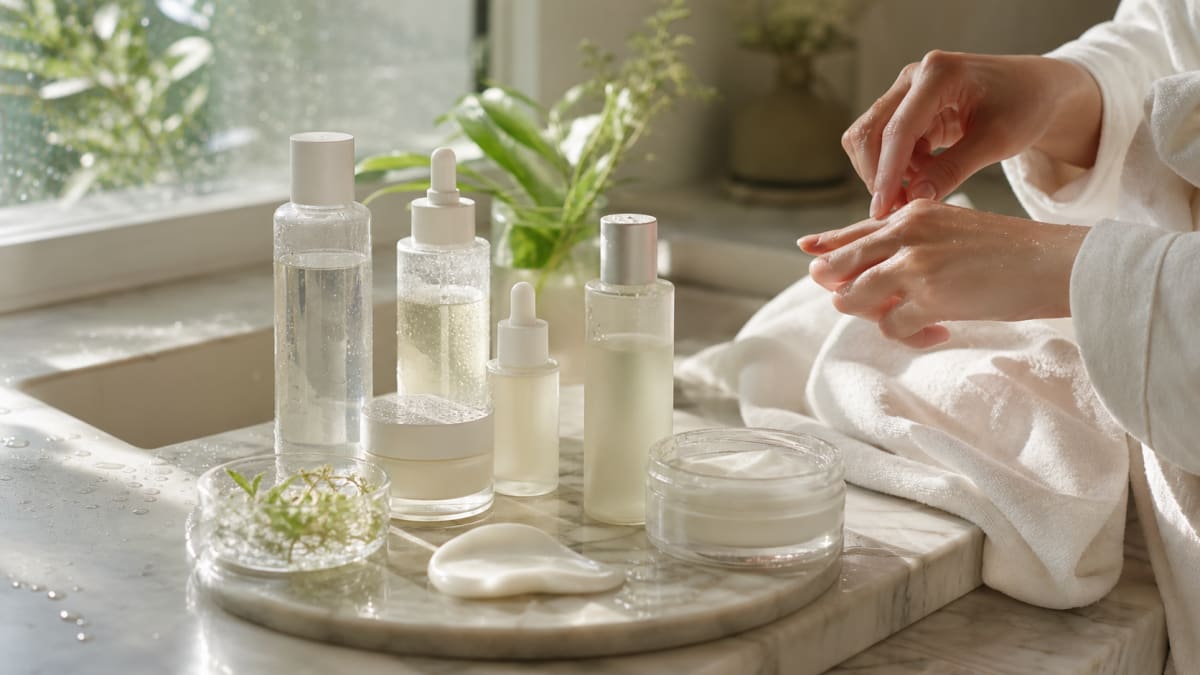
K-뷰티 (K-Beauty, Korean beauty) is now a global industry worth billions of dollars annually — with Korean skincare products sold in pharmacies and department stores across Europe, North America, and Southeast Asia. But the global popularity can obscure what makes Korean beauty culture actually distinctive. It is not primarily about the products. It is about a fundamentally different 철학 (philosophy) toward skin — one that treats skincare as long-term investment rather than short-term correction, and prevention rather than treatment.
K-뷰티 철학 (The K-Beauty Philosophy)
In most Western beauty culture, skincare is reactive: you notice a problem — 여드름 (acne), 건조함 (dryness), 주름 (wrinkles) — and you treat it. Korean skincare culture inverts this. The goal is to maintain 피부 장벽 (skin barrier) health continuously so that problems are less likely to occur. Hydration, sun protection, and gentle cleansing are the three pillars — applied daily, consistently, over years.
This philosophy has several practical implications:
보습 우선 (Hydration first): Korean skincare routines typically involve multiple hydration steps — 에센스 (essence), 세럼 (serum), 앰플 (ampoule), 크림 (cream) — layered in order of water content, lightest to heaviest.
자외선차단제 문화 (Sunscreen culture): 자외선차단제 (UV sunscreen) is non-negotiable in Korean beauty routines, worn daily regardless of weather or season. Korean sunscreen formulations are considered among the most advanced in the world — lightweight enough to wear comfortably under makeup, with high SPF protection.
순한 성분 (Gentle ingredients): Korean skincare tends toward ingredients that soothe and repair rather than aggressively exfoliate. The Western trend toward high-concentration actives (retinol, AHA, BHA at strong percentages) is balanced in K-Beauty with an emphasis on 피부 장벽 복원 (barrier restoration) alongside active ingredients.
K-뷰티 루틴 (The K-Beauty Routine)
The "10-step routine" is both real and somewhat mythologized. Most Korean women do not use all 10 steps every day — the number varies by skin condition, season, and time available. But the structure explains the logic:
단계 (Step) | 제품 (Product) | 목적 (Purpose) |
|---|---|---|
1 | 오일 클렌저 (Oil cleanser) | Remove sunscreen and makeup |
2 | 폼 클렌저 (Foam cleanser) | Deep cleanse skin |
3 | 토너 (Toner) | Balance pH; prep skin for moisture |
4 | 에센스 (Essence) | Cell renewal and hydration |
5 | 세럼·앰플 (Serum / Ampoule) | Concentrated active ingredients |
6 | 시트 마스크 (Sheet mask) | Intensive moisture treatment |
7 | 아이 크림 (Eye cream) | Targeted eye area care |
8 | 모이스처라이저 (Moisturizer) | Lock in moisture |
9 | 자외선차단제 (Sunscreen) | UV protection — daytime only |
10 | 슬리핑 팩 (Sleeping pack) | Overnight intensive repair — nighttime |
The key insight: the steps are modular. A minimal K-Beauty routine can be cleanser + toner + moisturizer + sunscreen. The elaboration is added based on 피부 고민 (specific skin concerns).
주요 성분 가이드 (Key Ingredients Guide)
K-Beauty has introduced several ingredients to the global skincare conversation — and popularized others that had been underused.
나이아신아마이드 (Niacinamide): A form of Vitamin B3. Brightens skin tone, reduces the appearance of 모공 (pores), and regulates 피지 (sebum). One of K-Beauty's most widely used brightening ingredients — found in toners, serums, and creams. Works for most skin types without irritation.
병풀 — 센텔라 아시아티카 (Centella Asiatica / Cica): Korean skincare reintroduced this plant extract — 병풀 (byeongpul) in Korean — as a soothing ingredient. Anti-inflammatory, promotes wound healing, and strengthens the skin barrier. Particularly popular for 민감성 피부 (sensitive skin) and post-breakout repair.
달팽이 점액 (Snail Mucin / Snail Secretion Filtrate): The most internationally surprising K-Beauty ingredient. Snail secretion filtrate was popularized by Korean brands like 코스알엑스 (COSRX) and 미존 (Mizon). Promotes skin regeneration, hydration, and reduces 흉터 (scarring). Clinically studied; the mechanism involves hyaluronic acid and glycoprotein enzymes naturally present in the filtrate.
히알루론산 (Hyaluronic Acid): A moisture-retaining molecule that holds up to 1,000 times its weight in water. K-Beauty layers it across multiple steps — as an essence, serum, and cream ingredient simultaneously — for sustained hydration throughout the day.
프로폴리스 (Propolis): Bee propolis extracts have antibacterial and antioxidant properties — popularized in K-Beauty for 피부결 개선 (skin texture improvement) and soothing. COSRX's propolis serum became one of the brand's signature global sellers.
레티놀 (Retinol): Korean formulations of retinol tend toward lower concentrations than Western equivalents — prioritizing skin barrier safety alongside 주름 개선 (anti-aging) efficacy. Often paired with barrier-repair ingredients like 세라마이드 (ceramide).
Tip — 성분표 읽기 (Reading Ingredient Lists): Korean cosmetics are regulated by the 식품의약품안전처 (Ministry of Food and Drug Safety, MFDS). Ingredients are listed on packaging in Korean — international INCI names appear on global exports. When shopping at 올리브영 (Olive Young), use the English-language Olive Young Global app for translated ingredient lists.
K-뷰티가 세계를 바꾼 방법 (How K-Beauty Changed Global Skincare)
Before 한류 (Hallyu) brought K-Beauty to global attention, sheet masks, essence products, and sunscreen as a daily step were not common in Western skincare routines. K-Beauty introduced or mainstreamed these formats:
시트 마스크 (Sheet masks): Popularized globally through K-Beauty; now produced and sold by virtually every major skincare brand worldwide
데일리 자외선차단제 (Sunscreen as daily habit): Normalized the idea of SPF 50+ worn every day, not just at the beach
에센스 레이어링 (Essence layering): A product format — light, watery, packed with active ingredients — that didn't exist in Western skincare before K-Beauty exports
The K-Beauty industry is regulated, innovation-driven, and operates on faster product development cycles than most Western equivalents — which partly explains the continuous stream of new ingredients and formats entering the market.
Key Facts
K-뷰티 핵심 철학 (Core philosophy) | Prevention over treatment; hydration (보습) and sun protection (자외선차단) as daily non-negotiables |
10단계 루틴 (10-step routine) | Oil cleanser → foam cleanser → toner → essence → serum → mask → eye cream → moisturizer → sunscreen → sleeping pack; modular — minimal version is 3–4 steps |
나이아신아마이드 (Niacinamide) | Vitamin B3; brightening, pore management, and sebum control — K-Beauty's flagship brightening ingredient |
병풀 (Centella Asiatica / Cica) | Soothing and barrier-strengthening; particularly effective for sensitive skin; a key plant ingredient K-Beauty introduced to the world |
달팽이 점액 (Snail Mucin) | Skin regeneration, hydration, and scar reduction; globally popularized by Korean brands including COSRX |
자외선차단제 문화 (Sunscreen culture) | SPF 50+ worn daily regardless of weather or season; Korean sunscreen formulations are recognized globally for their lightweight texture |
글로벌 영향 (Global impact) | K-Beauty established sheet masks, essence layering, and daily sunscreen as global skincare standards |
규제 기관 (Regulatory body) | 식품의약품안전처 (MFDS, Ministry of Food and Drug Safety) — regulates cosmetic ingredients and product safety in Korea |
Comments
Inappropriate comments may be deleted.
Log in to leave a comment.
No comments yet. Be the first!